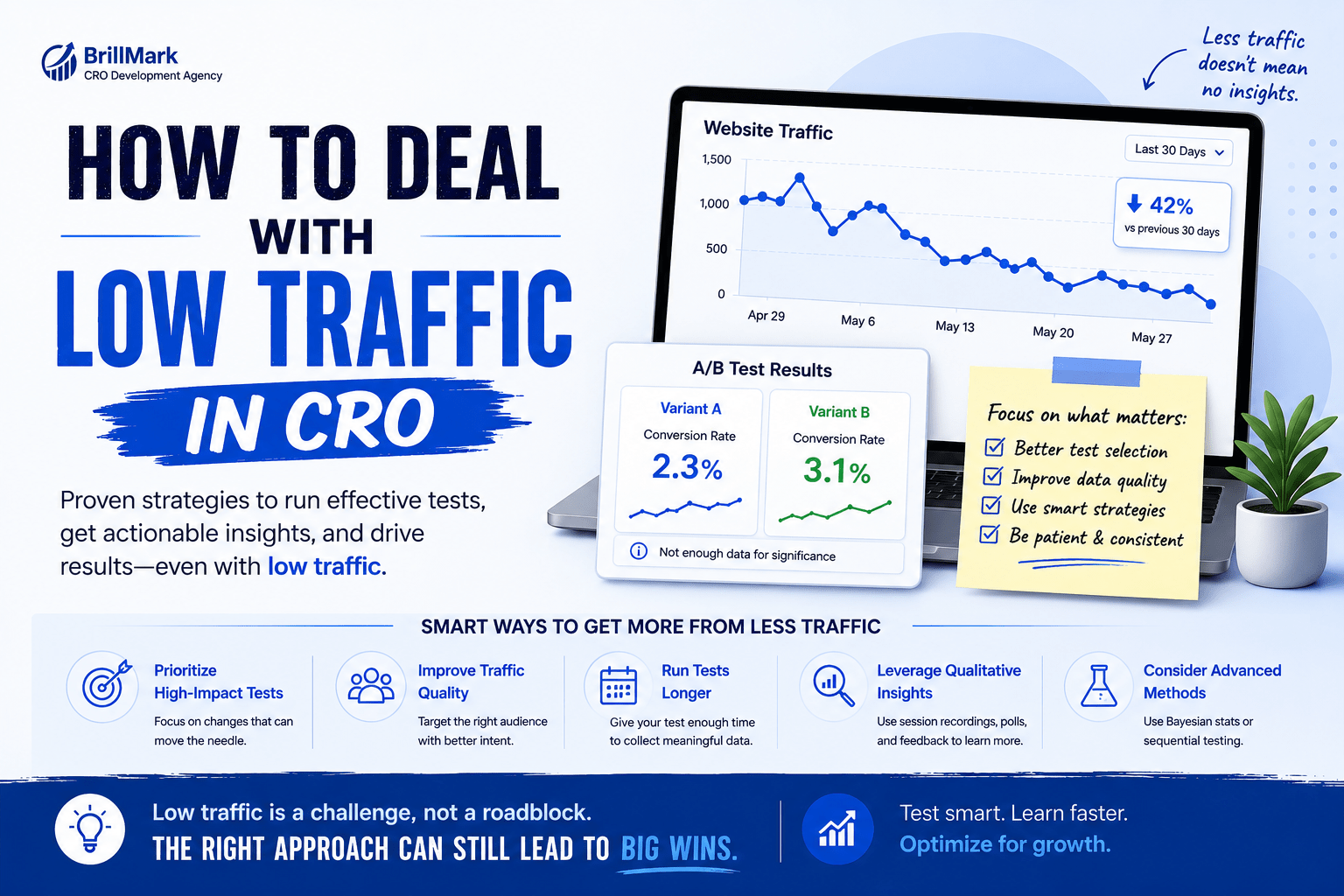
Most conversion rate optimization advice assumes you have tens of thousands of visitors a month to run clean A/B tests, but that’s not reality for most sites.
Low-traffic CRO is a different discipline: one built on statistical nuance, smarter prioritization, and testing methods that don’t require enterprise-scale volume to produce trustworthy answers.
This guide walks through what low traffic actually means statistically, why “I never reach significance” happens, and how to still run credible CRO with low traffic, drawing on frameworks from AB Tasty, Mouseflow, and Conversion Rate Experts.
What Does Low Traffic Mean in CRO?
No fixed number defines “low traffic,” but most experimentation teams agree that once a page generates only a few hundred conversions a month, standard A/B testing math starts to strain.
The issue isn’t visitors; it’s conversions per variant. A page with 50,000 visits but a 0.4% conversion rate can behave statistically like a “low traffic” page, even though the raw traffic number looks healthy.
This is the core challenge behind low-traffic conversion optimization: the statistical engine that powers most CRO programs needs volume of outcomes, not just sessions.
💡 The CRO Analogy
Think of A/B testing like a political poll:
- Polling 10,000 people gives a tight, reliable margin of error.
- Polling 50 people gives you a result too, but the margin of error is so wide the result is close to meaningless.
Low-traffic CRO suffers from the same issue: you can still run the test, but the “margin of error” (the confidence interval around your conversion rate) is often too wide to act on with confidence.
1. Solving “I Never Reach 95% Significance”
This is the single most common complaint from low-traffic teams: tests run for weeks, and the significance calculator never crosses the 95% line. The real issue usually isn’t the test; it’s the expectation that 95% is a fixed, mandatory bar for every business.
The Origin of the 95% Threshold
The 95% ($p < 0.05$) threshold comes from academic and pharmaceutical research, where the cost of a false positive (approving an ineffective or harmful drug) is extremely high.
It was never designed specifically for marketing experiments. In e-commerce and lead-gen CRO, the cost of being “somewhat wrong” about a homepage headline is nowhere near the cost of an unsafe drug reaching patients.
What Is the Appropriate Threshold for Low Traffic?
Practitioners working with low-traffic conversion optimization often adopt:
- 80–90% Confidence Intervals: Used as an acceptable decision threshold for lower-risk, easily reversible changes.
- Directional Evidence: Tracking tests trending positive across their full run alongside qualitative signals before shipping.
- Bigger Minimum Detectable Effects (MDE): Testing only changes expected to move conversion by 15–20%+, as smaller effects are simply undetectable at low volume.
The Importance of Bayesian Statistics
Bayesian A/B testing frames results as a probability (“There’s an 87% chance Treatment beats Control”) rather than a binary pass/fail significance test. This benefits low-traffic testing because:
- Continuous Updates: It updates continuously as data comes in rather than requiring a fixed, pre-calculated sample size.
- Clear Uncertainty: It naturally communicates nuance (“87% confident”) rather than a rigid pass/fail result.
- Actionable Risk: It enables teams to make informed, risk-adjusted decisions instead of waiting indefinitely for an arbitrary statistical threshold.
2. Are Statistics Valid with Small Numbers?
Yes. Statistically valid inference is still possible with small samples, but confidence intervals will be wide, meaning you must be comfortable acting on ranges rather than precise point estimates.
Best Practices for Small-Sample Validity
- Limit Test Variations: Use one-tailed tests only when justified, and avoid stacking multiple simultaneous comparisons without correction (which inflates false positives).
- Focus on Ranges: Report and act on confidence intervals rather than relying solely on a single conversion rate number.
- Avoid Daily Peeking: Do not stop a test as soon as numbers look favorable; this is one of the fastest ways to mistake noise for a winning variation.
3. Go “Upstream”
When a page itself doesn’t have enough conversions to test, move the experiment earlier in the funnel where volume is higher.
Practical Upstream Tactics
- Test Broader Pages: Run tests on the homepage or category pages instead of individual, low-traffic product pages.
- Track Micro-Conversions: Measure add-to-cart clicks, email signups, or scroll depth as proxy metrics when they occur more frequently than the final purchase.
- Use Template-Level Testing: Implement changes across all product pages at once rather than testing a single SKU to pool traffic across multiple pages.
4. Is the CUPED Technique Real?
Yes. CUPED (Controlled-experiment Using Pre-Experiment Data) is a well-documented variance-reduction technique originally published by Microsoft’s experimentation team.
How CUPED Works
CUPED uses a user’s historical behavior before an experiment to adjust their in-experiment metric. By subtracting out known baseline variability, CUPED isolates a cleaner signal of the actual treatment effect, reducing data noise without requiring a larger sample size.
When to Use CUPED
- Best Used For: Established sites with returning users, rich historical data, and recurring metrics like revenue or engagement.
- Less Effective For: New visitors with no history, brand-new websites, or newly launched pages lacking baseline data.
Can You Still Improve Conversions with Low Traffic?
Absolutely. Formal A/B testing is only one tool in CRO. The most productive path combines:
- Qualitative Research: Session recordings, heatmaps, and user surveys that don’t rely on large sample sizes.
- Heuristic UX Audits: Expert reviews that identify objectively broken site experiences without needing traffic.
- Before/After Rollouts: Shipping a change to 100% of traffic and comparing performance to a prior baseline period instead of splitting thin traffic.
What Strategies Work Best?
- Prioritize Sample-Independent Research:
- Heatmaps & Recordings: Identify friction points with as few as 50–100 sessions using tools like Mouseflow.
- On-Site Surveys: Run exit-intent polls to discover the “why” behind drop-offs.
- Usability Audits: Evaluate clarity, load speeds, trust signals, and form length against proven best practices.
- Focus on High-Impact Pages:
- Target homepages, top landing pages, and primary navigation first.
- Reserve lower-traffic pages (like individual product pages or deep checkout steps) for qualitative UX audits rather than formal split tests.
- Favor High-Confidence Changes:
- Implement clear value propositions, shorter forms, and faster page loads over subtle design tweaks that require high volume to detect.
When Should You Start A/B Testing?
You are ready for formal A/B testing when:
- Sufficient Volume: You generate enough weekly conversions to complete a test within a 4–8 week window.
- Isolated Variables: The change being tested is clear and well-defined.
- Baseline Resolved: You have already resolved obvious usability issues through UX audits, ensuring tests measure true hypothesis uncertainty rather than known bugs.
Ready to Build a CRO Program That Fits Your Actual Traffic?
Low-traffic CRO isn’t about lowering your standards- it’s about matching your methodology to your actual data, whether through Bayesian statistics, CUPED, or qualitative research.
Brillmark helps businesses build experimentation programs sized for their real traffic, offering analytics implementation, tailored CRO strategy, and rigorous QA validation.
Explore Brillmark’s full range of CRO services or reach out today to build a low-traffic experimentation framework tailored to your site.