What is multi-armed bandit testing?
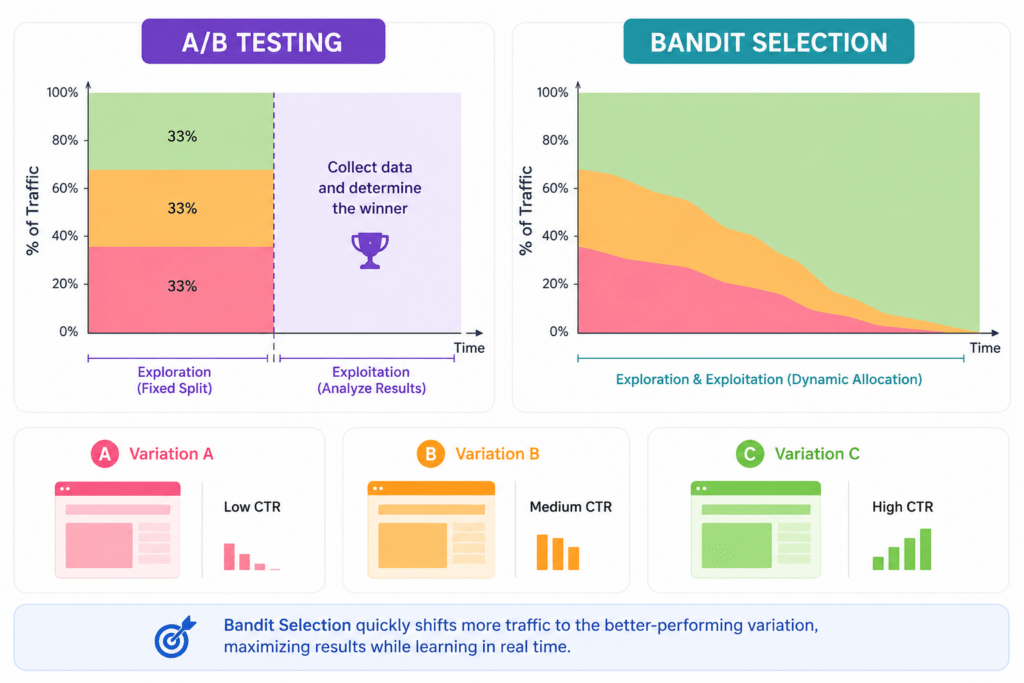
Multi-armed bandit (MAB) testing is an adaptive experimentation method that uses reinforcement learning algorithms to shift traffic toward better-performing variations while the test is still running. Instead of holding a fixed 50/50 split until a fixed sample size is reached, a bandit re-weights allocation continuously, so more visitors see the currently leading variation, and fewer see the losers.
That single design choice changes what the test is for. An A/B test is built to produce a defensible causal estimate. A bandit is designed to maximize conversions during the learning period. Both are legitimate. They are not interchangeable.
An adaptive experimentation method that uses machine learning algorithms to shift traffic toward better-performing variations in real time dynamically.
When an individual user interacts with a system governed by an MAB algorithm, the platform evaluates the cumulative historical performance of each variant alongside the system’s current uncertainty parameters. The algorithm then determines whether to route the user to the current best-performing variant or to an alternative option to gather additional performance data. As data accumulates, the system systematically shifts traffic toward superior variations while restricting traffic to underperforming ones.
Multi-armed bandit vs A/B testing
| Dimension | A/B test | Multi-armed bandit |
| Core objective | Causal inference and effect-size measurement | Cumulative yield; regret minimisation |
| Traffic allocation | Fixed and static (e.g. 50/50) | Dynamic, re-weighted on performance |
| When you get value | After the test concludes | During the test |
| Statistical output | Valid p-values, unbiased confidence intervals | Total conversions earned; inference is compromised |
| Metric handling | Comfortably tracks many metrics and guardrails | Optimises one reward signal; secondary metrics are unprotected by default |
| Exposure to losers | Higher half your traffic, for the full runtime | Lower is throttled as evidence builds |
| Analysis complexity | Straightforward | Requires bias-corrected estimators |
| Best fit | Redesigns, pricing, structural changes, regulated decisions | Short campaigns, creative selection, many-variant selection, recommender cold starts |
The shortest way to hold the difference: A/B testing tells you what is true; a bandit gets you paid while it figures it out.
How Multi-Armed Bandit Tests Work
Each time a visitor arrives, the algorithm looks at two things: the accumulated performance of every arm, and how uncertain those performance estimates still are. It then decides whether to serve the current leader or serve something else to reduce that uncertainty. As evidence accumulates, allocation drifts toward the stronger arms.
| Algorithm | Decision rule | Practical character |
| Epsilon-greedy | Serve the leader (1 − ε) of the time; serve a random arm ε of the time | Simplest to reason about and to debug. Exploration rate is fixed, so it keeps spending traffic on known losers forever unless you decay ε. |
| Upper Confidence Bound (UCB) | Serve the arm with the highest optimistic bound (mean + uncertainty term) | Deterministic and aggressive about testing arms it knows little about. Converges cleanly on stable traffic. |
| Thompson Sampling | Draw a sample from each arm’s posterior distribution; serve the arm with the highest draw | Bayesian and probabilistic. Explores in proportion to the chance an arm is actually best, which usually gives the best regret performance in digital settings. The most common implementation in commercial platforms. |
| Contextual bandits | Predict each arm’s outcome given this user’s attributes, then select | Doesn’t look for one global winner. Looks for the right variant per segment, device, geography, referral source, past behaviour. Effectively lightweight personalisation. |
The distinction in that last row matters more than it looks. A standard MAB answers “which variant is best?” A contextual bandit answers “which variant is best for this person?” Those are different products with different data requirements, and vendors use both names loosely.
When To Use Multi-Armed Bandit Testing
High opportunity cost. When every visitor routed to a weak variant is a real, quantifiable loss. a 48-hour flash sale, a paid campaign burning budget by the hour, regret minimisation is the correct objective, not statistical certainty.
Short experimentation horizons. When the campaign itself only lives for days, there is no fixed-horizon sample size to wait for. The test window closes before a classical design would finish.
Large variant action spaces. Twenty headlines or fifty ad images split evenly gives you fifty underpowered arms. Bandits handle wide action spaces by starving the obvious losers early and concentrating traffic where the contest is actually close. GrowthBook’s own guidance puts the threshold at roughly four or more variations.
Personalisation and contextual targeting. When the best variant genuinely differs by segment, a contextual bandit captures that instead of averaging it away into a single mediocre winner.
Continuous algorithmic tuning. Back-end parameters, recommendation weights, search re-ranking, and routing thresholds have no clean “launch moment” and no user-facing disruption. Always-on adaptive optimisation fits naturally.
When Not To Use Multi-Armed Bandit Testing
- Major UI/UX redesigns. A disruptive change needs a clean baseline and a stable population to measure real adoption. Shifting allocation mid-flight means returning users can be re-bucketed into a different experience, which corrupts retention and engagement readings. If you must run adaptive allocation on returning users, sticky bucketing is mandatory, not optional.
- Regulatory or compliance validation. Anything requiring pre-registered hypotheses and defensible p-values clinical decisions, financial risk models, legal substantiation for claims needs fixed-horizon testing. Optimizely’s documentation is blunt about this: MAB optimisations do not produce statistical significance at all.
- Low-traffic environments. This is the most common misconception, so it is worth stating plainly: bandits do not solve a traffic problem. With thin volume, reward estimates stay wide, the algorithm never converges, and it sits in an extended exploration phase that performs no better than a uniform split while giving you worse inference than the split would have.
- Delayed feedback loops. If the reward signal takes weeks to materialise subscription renewal, loan default, 90-day retention there is nothing for a real-time algorithm to react to. Bandits need fast, measurable rewards that correlate with the outcome you actually care about.
- Multi-metric conflicts. Where lifting the primary metric plausibly damages a secondary one, a single-objective bandit will happily walk straight into that trade-off. You need a multi-objective formulation with an explicit scalarisation, or guardrails enforced outside the algorithm.
Common mistakes
1. Treating the MAB winner as statistically validated
A frequent error among experimentation teams is applying standard Frequentist confidence intervals and P -values to the winning arm of an MAB experiment. Because bandit algorithms continuously adjust traffic toward higher-performing arms, the sample collection process is adaptively biased. Standard hypothesis testing formulas assume independent, unselected observations. Applying standard statistical formulas to MAB data introduces severe selection bias, producing inflated false-positive rates and falsely narrow confidence intervals.
2. Running MAB when conversion rates aren’t stable
Multi-armed bandit algorithms typically assume stationary reward distributions—meaning the underlying conversion probability of an arm remains constant over time. If an experiment runs during a period with highly variable traffic (such as Black Friday, an unexpected server outage, or a viral press campaign), reward distributions shift unpredictably. Early non-stationary spikes can cause a bandit algorithm to prematurely choke traffic to an arm that is optimal under normal operational conditions.
3. Changing a variant mid-test
Modifying the underlying code, creative asset, or configuration of an active arm while an MAB test is running invalidates accumulated statistical memory. For Bayesian models like Thompson Sampling, modifying an arm corrupts the posterior distribution, forcing the algorithm to make decisions using obsolete historical data. If a variant must be updated, the existing arm should be retired, and a new arm initialized.
4. Ignoring secondary metrics
Single-objective multi-armed bandits focus exclusively on maximizing their designated target metric (e.g., Click-Through Rate). If an MAB framework tests article headlines, it may quickly converge on sensationalized, clickbait titles that maximize immediate clicks while damaging long-term user retention, brand trust, and dwell time. Multi-Objective Multi-Armed Bandits (MO-MAB) using scalarization functions must be deployed when secondary guardrail metrics are present.
5. Expecting MAB to fix a low-traffic problem
Experimenters occasionally deploy MAB testing under the false assumption that adaptive algorithms eliminate minimum sample size requirements. MAB minimizes regret during data collection, but it cannot bypass fundamental laws of statistical variance. In low-traffic environments, the variance of reward estimates remains wide, forcing algorithms like UCB and Thompson Sampling to remain in a continuous exploration phase that performs no better than a standard uniform random split.
Key takeaways: smarter experiments, faster wins
Multi-armed bandit testing provides an efficient framework for real-time online optimization, closing the gap between data collection and value realization. By shifting from static hypothesis validation to dynamic reinforcement learning, enterprises can reduce opportunity costs, scale automated micro-experiments, and deliver hyper-personalized user experiences. Selecting the appropriate experimentation methodology requires matching the algorithm to the operational objective.
| Decision Criteria | Traditional A/B Testing | Multi-Armed Bandit Testing |
| Core Objective | Scientific proof & effect size measurement | Cumulative yield optimization & regret minimization |
| Traffic Split | Fixed static percentage (e.g., 50/50) | Dynamic, performance-based auto-reallocation |
| Optimal Use Cases | Major UX redesigns, pricing changes, regulatory validation | Short campaigns, ad creatives, recommender cold-starts |
| Risk Profile | Higher user exposure to inferior variants | Lower user exposure to inferior variants |
| Statistical Output | Valid $p$-values and unbiased confidence intervals | Maximized total conversions during the test period |
Why Classical A/B Testing Outperforms Multi-Armed Bandits in Enterprise Decision-Making
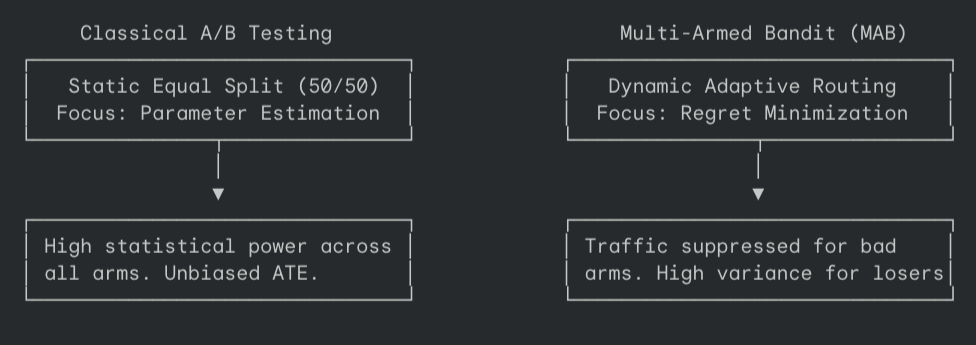
While Multi-Armed Bandit (MAB) algorithms offer an efficient strategy for dynamic traffic optimization, classical Frequentist A/B testing grounded in Null Hypothesis Significance Testing (NHST) remains the standard for rigorous enterprise experimentation. The superiority of A/B testing in strategic product development stems from fundamental differences in mathematical objectives: A/B testing optimizes for scientific learning and precise causal estimation, whereas MAB optimizes for immediate reward collection.
Below is a detailed breakdown of the statistical, operational, and structural reasons why product teams and data scientists frequently favor A/B testing over MAB.
Parameter Estimation vs. Exploitation
When to Choose A/B Testing
Classical A/B testing is definitively the superior choice when:
- Validating Major Strategic Pivots: Core UI/UX overhauls, pricing architecture changes, or structural algorithm modifications require scientific rigor and executive confidence.
- Measuring Average Treatment Effect (ATE): You need exact point estimates and tight confidence intervals to calculate return on investment (ROI).
- Protecting Guardrail Metrics: You must ensure that increasing short-term conversion does not harm long-term retention, customer lifetime value (LTV), or operational costs.
- Operating in High-Noise / Seasonal Environments: Customer behavior varies significantly across days of the week or promotional cycles.
Benefits of Multi-Armed Bandit (MAB) testing
- Maximizes Conversions During the Test
- Sends more traffic to better-performing variations as data comes in.
- Reduces lost conversions from poor-performing versions.
- Learns and Optimizes at the Same Time
- Continuously explores new variations while exploiting the current winner.
- No need to wait until the test ends to improve results.
- Reduces Opportunity Cost
- Fewer visitors are exposed to underperforming experiences.
- Helps capture more revenue while experimenting.
- Works Well with Low Traffic
- Makes better use of limited visitors.
- Can reach useful decisions faster than traditional A/B testing in some cases.
- Automatically Adjusts Traffic Allocation
- Traffic shifts dynamically based on performance.
- Requires less manual intervention.
- Faster Response to Changing Trends
- Adapts if user behavior changes over time.
- Useful for seasonal campaigns and fast-moving promotions.
- Ideal for Continuous Optimization
- Great for always-on experiments where there’s no fixed end date.
- Keeps improving as more data becomes available.
- Higher Overall Business Impact
- Increases cumulative conversions and revenue throughout the experiment.
- Delivers value before the experiment is complete.
Best Use Cases
- Product recommendations
- Email subject line optimization
- Homepage banners
- Paid advertising creatives
- E-commerce promotions
- Personalized content
- Mobile app onboarding flows
In short: Traditional A/B testing focuses on finding the best variation, while Multi-Armed Bandit focuses on getting the best results while learning which variation is best.
Which platforms support bandit testing
Bandit support has become close to table stakes across the experimentation market. Capabilities and plan tiers change often, so confirm against current vendor documentation before you commit to an implementation:
| Platform | Bandit support | Notes |
| Optimizely | Yes | Multi-armed bandit is a distinct distribution mode (formerly “Accelerate Impact”), separate from Stats Accelerator — which is also bandit-family but aims at reaching significance faster, not at minimising regret. A contextual bandit mode is also available. MAB runs do not report statistical significance. |
| VWO | Yes | Bandit-based dynamic allocation for web experiments. |
| Adobe Target | Yes | Auto-Allocate is a multi-armed bandit that reserves 20% of traffic for continuous exploration; Auto-Target and Automated Personalization apply profile-level ML models. |
| Kameleoon | Yes | Both multi-armed bandit and contextual bandit allocation, selectable per experiment. |
| Convert Experiences | Yes | MAB testing with a choice of three algorithms. |
| GrowthBook | Yes | Bandits built on Thompson Sampling, on Pro and Enterprise plans. Requires a single decision metric; sticky bucketing recommended for returning users. |
| Eppo (now Datadog Experiments) | Yes | Contextual bandits, integrated with warehouse-native experiment analysis so bandit performance can be measured against a control. |
| Dynamic Yield | Yes | Bandit-driven allocation within its personalisation engine. |
| Amazon Personalize | Yes | Contextual bandit techniques applied to recommendation use cases rather than general web experimentation. |
- Choose A/B Testing when you need absolute certainty. If you are changing your pricing model, redesigning your core website, or rolling out a high-stakes product feature, you need reliable, unbiased data and statistical proof before committing long-term.
- Choose Multi-Armed Bandits when time is short, and opportunities expire. If you are running a 48-hour promotional sale, testing news headlines, or optimizing ad variations, MAB automatically routes traffic to top performers so you don’t waste precious time and traffic on losers.
Key Takeaways
1. Pick the tool based on the lifecycle
Use MAB for short-lived, high-volume campaigns where speed matters more than statistical depth. Use A/B testing for foundational business decisions where deep customer insights and long-term impact matter most.
2. Don’t fall into the “False Winner” trap
MAB algorithms are vulnerable to early-data noise and temporary trends (like day-of-week biases). Never treat a Bandit “winner” as permanent brand wisdom without validating it across broader contexts.
3. Modern experimentation uses both
Leading growth teams don’t pick a side. They run A/B tests to establish core strategic direction and deploy Multi-Armed Bandits in automated pipelines to optimize messaging, recommendations, and short-term promotions at scale.
At BrillMark, we see experimentation not as a single tool, but as a flexible framework. Neither A/B testing nor Multi-Armed Bandit (MAB) testing is universally “better”, they are distinct statistical mechanisms engineered for fundamentally different business objectives.
Test design, platform integration, and clean code execution are where most experimentation programmes actually stall. Sticky bucketing, flicker-free variant delivery, bias-corrected analysis of adaptive tests, and reliable event instrumentation across Optimizely, VWO, Adobe Target, Kameleoon, LaunchDarkly, and Statsig are engineering problems, not strategy problems.
BrillMark’s CRO development team handles that end-to-end execution, building complex variations, implementing custom bandit pipelines, and making sure your test code runs fast and clean. so your team can stay on insights and growth.
Talk to our CRO engineering team →
Make your website ready for the AI era.
AI is changing how people discover, evaluate, and interact with websites. We help you identify optimization opportunities across content, UX, technical performance, SEO, and conversion paths.