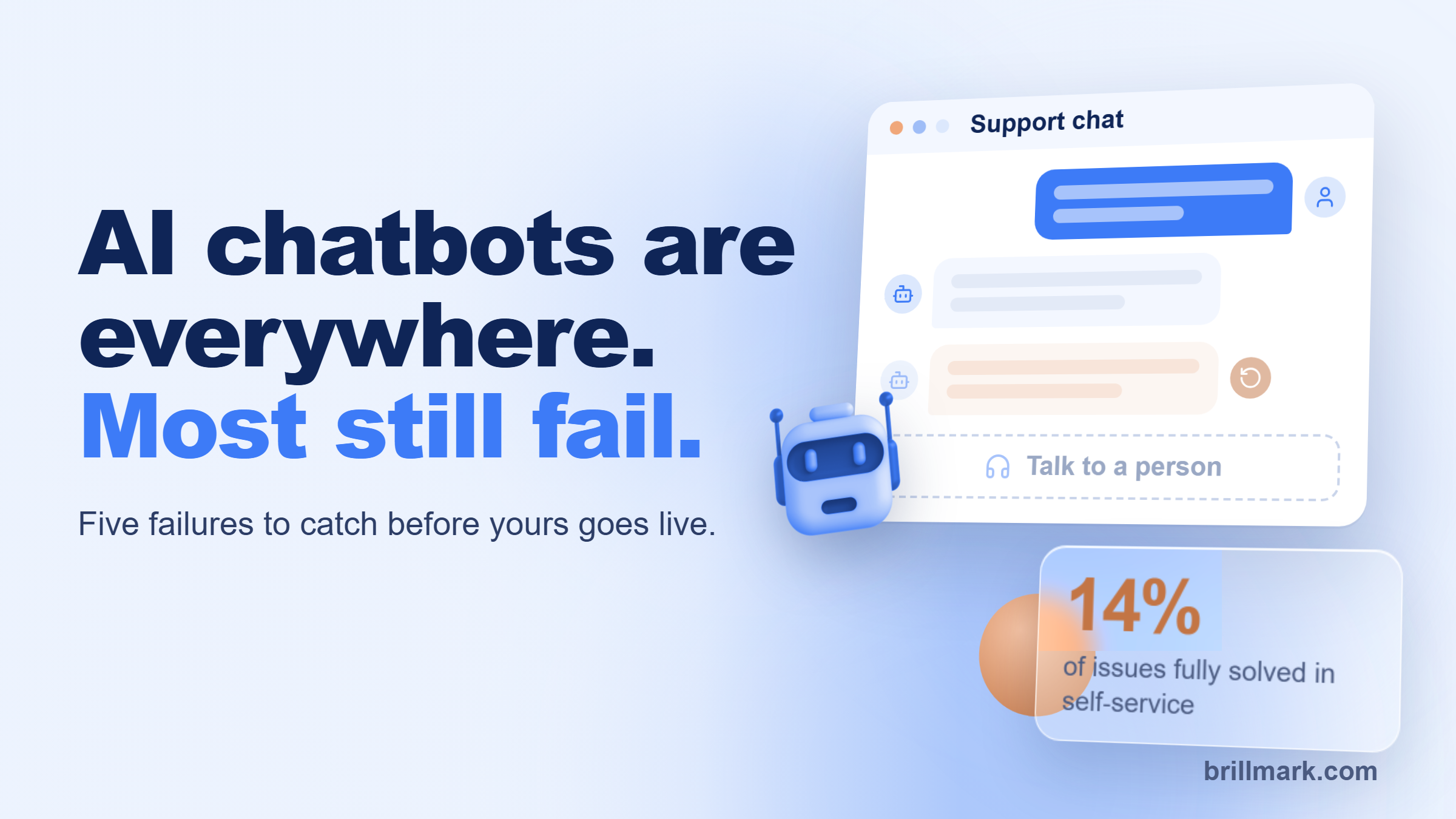
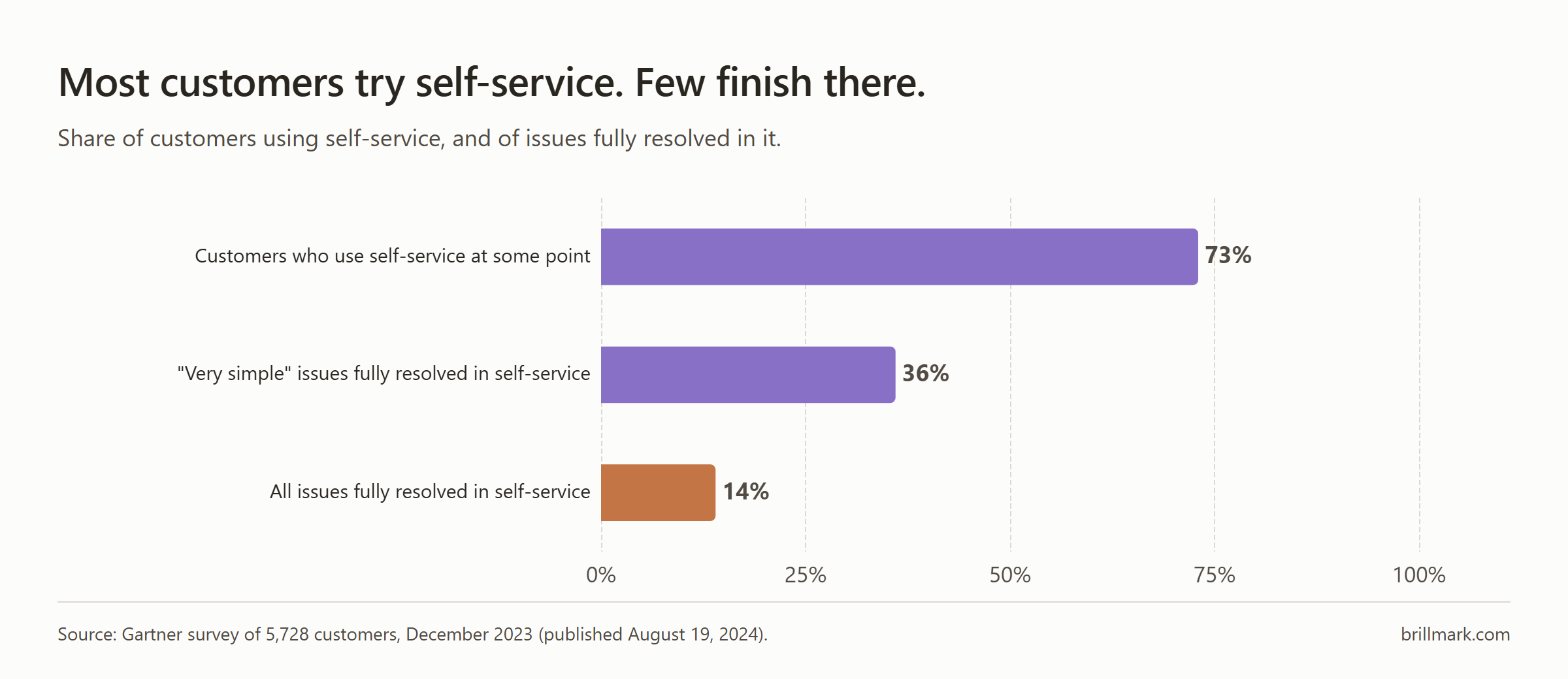
If you want to know why AI chatbots fail, start with one number. Only 14% of customer service issues get fully resolved in self-service, according to a Gartner survey of 5,728 customers. Self-service means everything a customer can use without a person: the chat window, the help centre, the FAQ page.
Customers have noticed. In a second Gartner release from the same survey, 64% said they would prefer companies didn’t use AI for customer service at all, and 53% said they would consider switching to a competitor over it.
So why do AI chatbots fail so often? Usually the AI works. However, the business around it was never set up for the job. Below are five ways it goes wrong. The first four match the four jobs a chatbot is given: answer, act, suggest and route. The fifth is who looks after it. Then a five-question check to run before yours goes live.
Why AI chatbots fail: the short answer
In short, most AI chatbots fail because they are built as a talking FAQ page. They can’t find the right answer, can’t do what the customer came to do, can’t help them choose, and can’t send the case to the right person. The language model is rarely the weak part.
Gartner also asked the customers who started in self-service what went wrong. In 43% of cases they couldn’t find content relevant to their issue. And 45% said the company didn’t understand what they were trying to do.
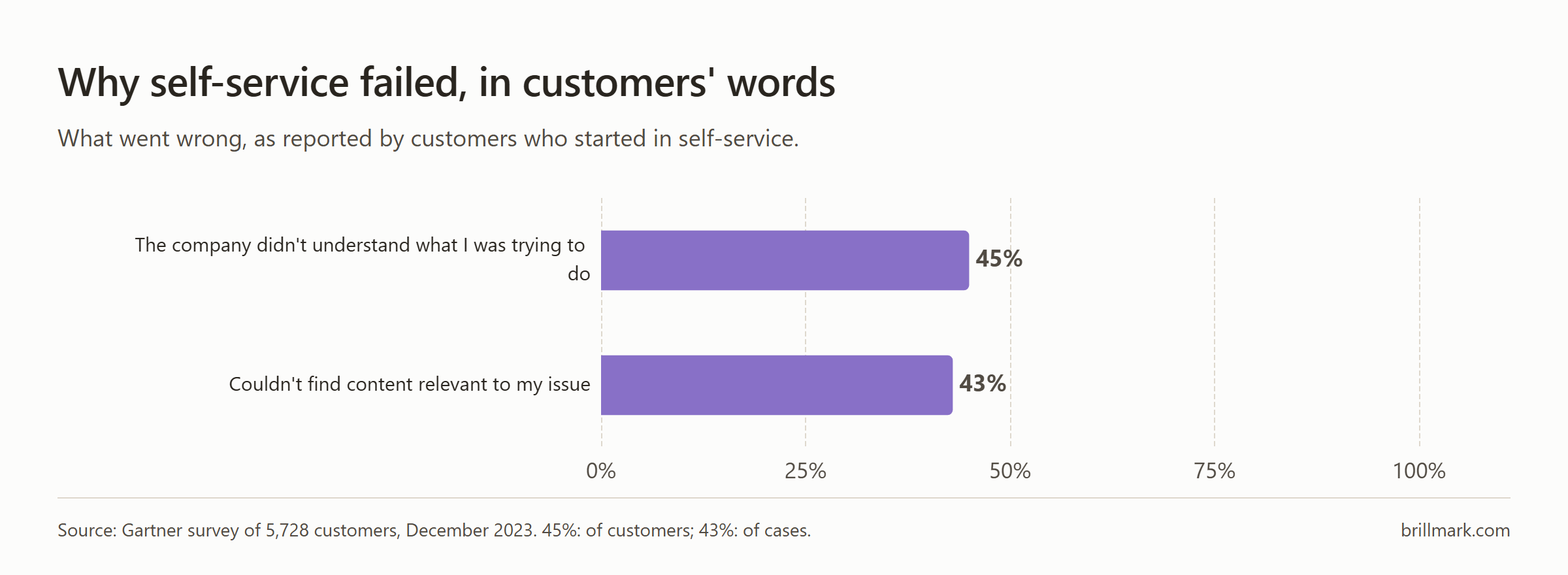
In other words, both point at what the business gave the bot to work with. A chatbot can only be as good as the answers and the access you give it.
1. It answers from the wrong source, or from none
A chatbot without approved, current answers behind it will do one of two things: say “I don’t know” to most questions, or make something up that sounds right.
The second is worse. For example, in February 2024, a Canadian tribunal ruled against Air Canada after its website chatbot told a grieving customer they could claim a bereavement discount after booking. However, the airline’s policy said otherwise. Air Canada argued the chatbot was responsible for its own actions. The tribunal called that “a remarkable submission” and ordered the airline to pay C$812.02.
The fix is dull and it works: decide which pages, policies and product data the bot may use, keep them current, and tell it to say so when the answer is not there. Whatever your chatbot tells a customer, your company has told them.
2. It can talk, but it can’t do anything
Most people open a chat window to get something done: track a parcel, change an address, start a return, book a slot. However, a chatbot that can only explain the process sends them away with a link instead. That is the 45% who said the company didn’t understand what they were trying to do.
DPD found out in public. In January 2024 a customer couldn’t get the delivery firm’s chatbot to tell him anything useful about a missing parcel. Bored, he got it to swear and write a poem about how bad DPD was. His post was viewed 800,000 times in 24 hours.
So list the five things customers ask for most. If the bot can’t look up an order, it can’t answer “where is my order”. If the top requests need an action, a bot that only talks will fail at most of them.
3. It answers questions but never helps anyone choose
A lot of chat traffic happens before the sale. “Which plan suits a team of 12?” “Is the 40L bag big enough for a week away?” “What’s the difference between your two service packages?” A support bot answers with a link to the pricing page. As a result, the customer leaves to compare elsewhere.
Customers now expect better. In McKinsey’s 2021 personalization research, 71% of consumers said they expect companies to deliver personalized interactions, and 76% said they get frustrated when that doesn’t happen.
A chatbot that knows your catalogue and your rules can do what a good salesperson does:
- Compare two products or service tiers side by side, on the details the customer asked about.
- Suggest the option that fits their answers, and say why.
- Offer the accessory or add-on that goes with what they are buying, or the upgrade when they have clearly outgrown their plan.
- Use what a signed-in customer has already bought, where they have agreed to it, so a returning buyer isn’t treated like a stranger.
The rule that keeps this from turning into spam: answer the question first, suggest only what fits it, and suggest it once. Pre-sale questions are buying signals, and a support-only bot throws them away.
4. It sends every case to the same place, or nowhere
The worst version has no exit at all. The US Consumer Financial Protection Bureau calls it a “doom loop”: the bot can’t solve the problem and there is no “offramp to a human customer service representative”. In Gartner’s survey, customers’ top concern about AI in customer service was that it would get harder to reach a person.
Still, the common version is quieter. There is a “talk to a person” button, but every case lands in one general queue, and the customer explains everything again. A double charge waits behind a sizing question. A buyer ready to order 200 units waits behind both.
Intelligent routing means the bot reads what the customer wants and how urgent it is, then sends billing problems to billing, sales-ready leads to sales, and an angry customer or a large order to someone senior. Then the conversation goes with it, so nobody starts again.
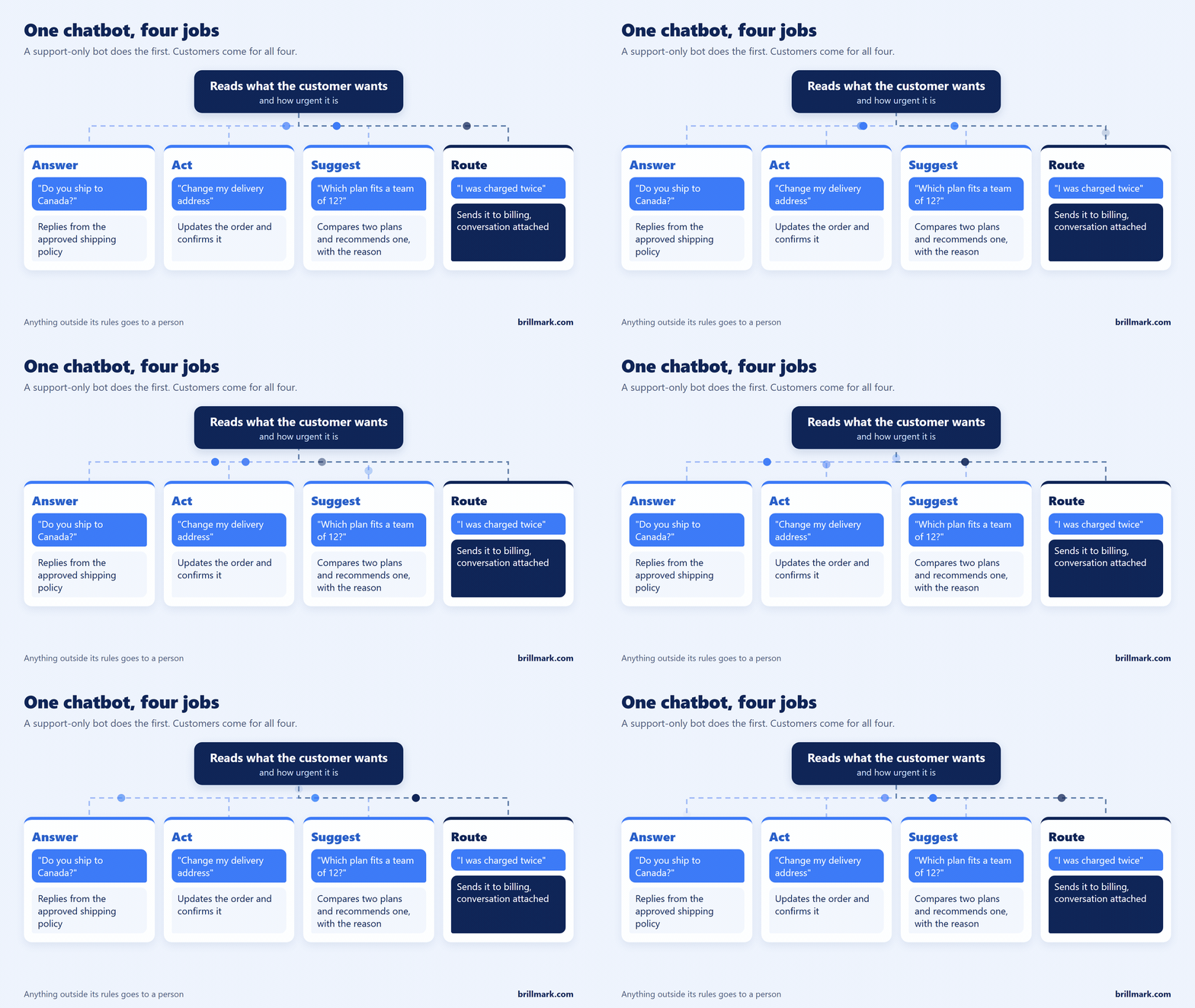
That is the shape our custom AI agent and helpdesk builds keep landing on: answer from approved knowledge, take approved actions within rules you define, and hand over or ask for approval when a decision is outside the agent’s authority. Routing to the right person is part of the chatbot, so design it before launch.
5. Nobody owns what it says
In fact, a chatbot launch is the start of the job. Prices change, policies change, products go out of stock, and someone has to update what the bot knows. Someone also has to read its conversations every week and test it after every change.
DPD’s swearing bot is a good example here too. The company said it had run an AI element in its chat “successfully for a number of years” and that “an error occurred after a system update.” As a result, one untested change undid years of working fine.
Ownership also means measuring the right thing. A chat that ends without a ticket is often counted as a win, even when the customer gave up and phoned instead. Count the issues the bot actually solved and the sales it helped close.
Ownership goes wrong fastest when the bot was bought to cut the team. Gartner predicts that by 2027, 50% of organisations that expected to significantly cut their customer service workforce will abandon those plans, and in its March 2025 poll of 163 service leaders, 95% planned to keep human agents. A bot with no people behind it has nobody to update it and nowhere to route the hard cases. If nobody’s job is to check the chatbot, nobody will notice when it breaks.
The five-question check before you launch
Most of why AI chatbots fail can be caught before launch. Run this against your own plan. If any answer is no, fix it before go-live, not after the first screenshot.
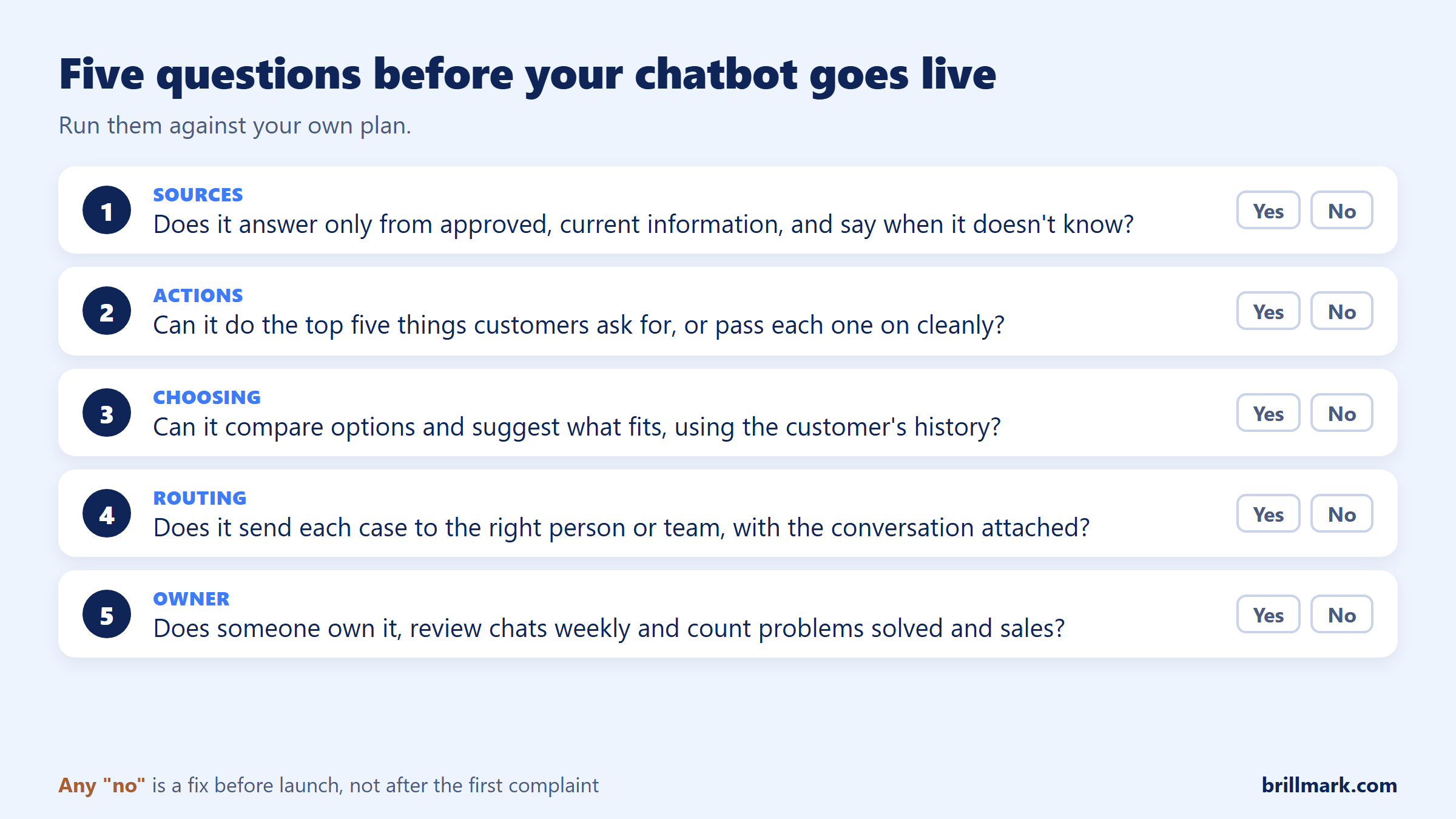
- Sources: Does it answer only from approved, current information, and say so when it doesn’t know?
- Actions: Can it do the top five things customers ask for, or pass each one on cleanly?
- Choosing: Can it compare options and suggest what fits, from your catalogue and the customer’s history?
- Routing: Does it send each case to the right person or team in one step, with the conversation attached?
- Owner: Does a named person own it, review conversations weekly, and count problems solved and sales assisted?
FAQ
Are AI chatbots worth it for small businesses?
They can be, if most of your questions repeat and the answers are written down. If most of your requests need a lookup, a recommendation or a decision, a chatbot that only answers will frustrate people. You need one connected to your systems, or a person.
Can an AI chatbot upsell and cross-sell?
Yes, if it can read your product catalogue and your rules for what goes with what. Keep it to one relevant suggestion after the customer’s question is answered. A pitch that blocks the answer costs you more than it earns.
What is a chatbot doom loop?
A doom loop is when a chatbot can’t solve a problem and keeps the customer going round in circles with no way to reach a person. The CFPB used the term in its 2023 report on chatbots in banking.
Is a business liable for what its chatbot says?
In the Air Canada case, yes. The tribunal held the airline responsible for its chatbot’s wrong answer and ordered it to pay C$812.02. Treat every chatbot answer as a statement from your company.
What is the difference between a chatbot and an AI agent?
A chatbot answers questions. An AI agent can also take actions in your systems, such as looking up an order or issuing a return label, within rules you set. We compare the two, plus marketing automation, in AI agent vs AI chatbot vs marketing automation.
How do you know if your chatbot is working?
Count the issues it fully resolves, the sales it assisted, how often customers ask for a person, and how many contact you again about the same problem within a few days. A low ticket count on its own doesn’t tell you much.
Planning a chatbot that should answer, sell and route? BrillMark builds custom AI agents grounded in your approved knowledge and connected to your systems, taking approved actions within rules you define. Get a free working prototype built from your website and one real customer journey.
Make your website ready for the AI era.
AI is changing how people discover, evaluate, and interact with websites. We help you identify optimization opportunities across content, UX, technical performance, SEO, and conversion paths.