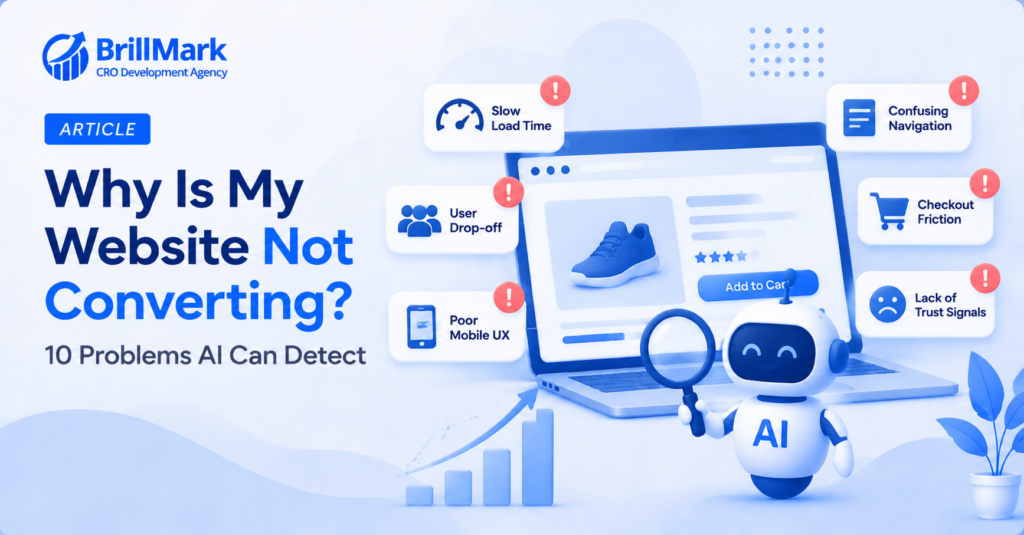
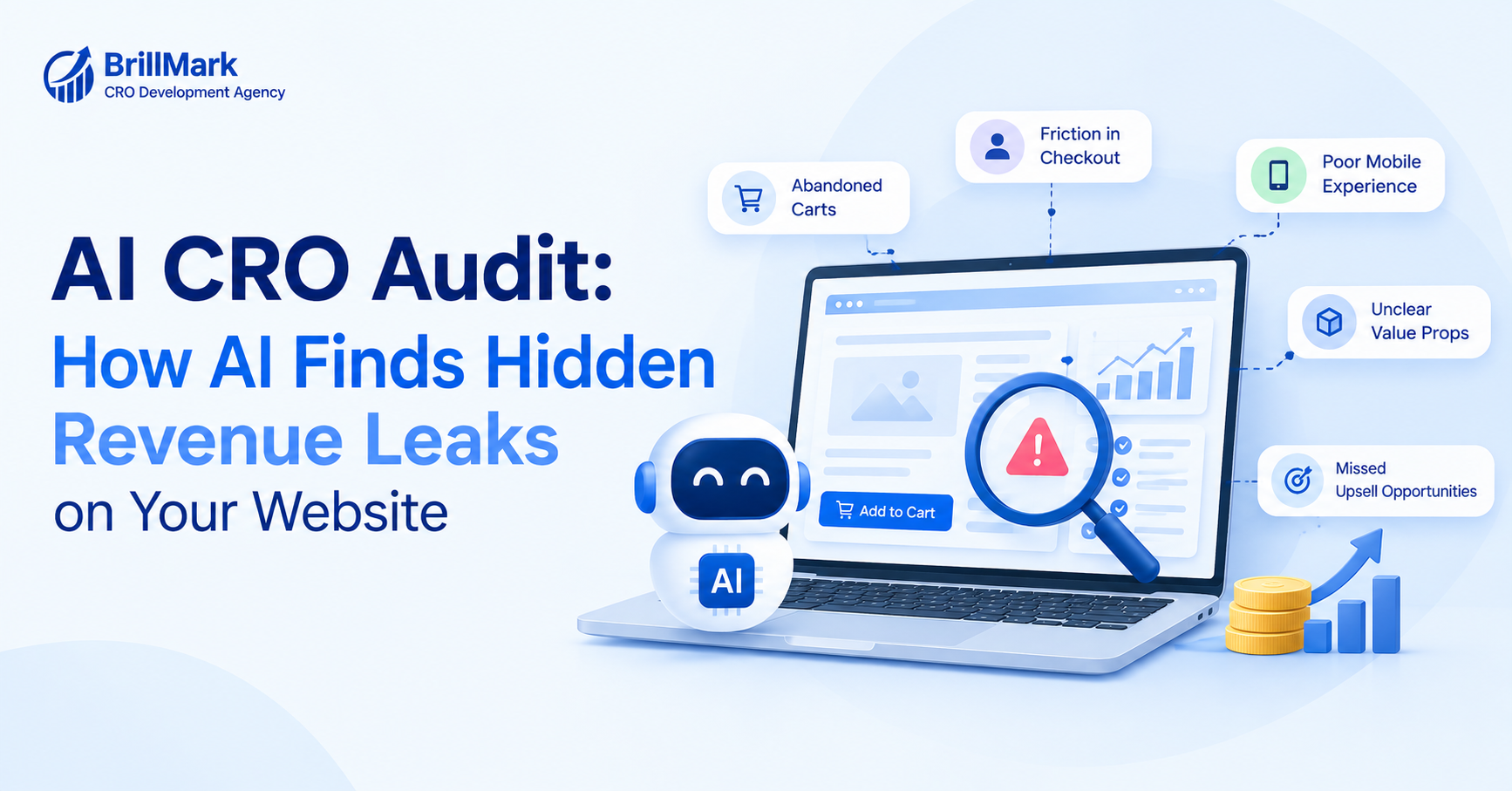
Most websites lose revenue in places nobody is actively watching. A confusing filter on a category page. A checkout step that quietly frustrates mobile users. A pricing page that reads clearly to the team but confuses first-time visitors. Traditional CRO audits catch some of these issues. However, they rely on a human manually reviewing a limited set of pages and sessions. AI changes that equation considerably, since it can review far more data than any individual analyst realistically could.
Below is a practical look at how AI-driven CRO audits actually work. It also covers what kinds of revenue leaks they tend to catch, and where human judgment still matters most.
What Counts as a Hidden Revenue Leak
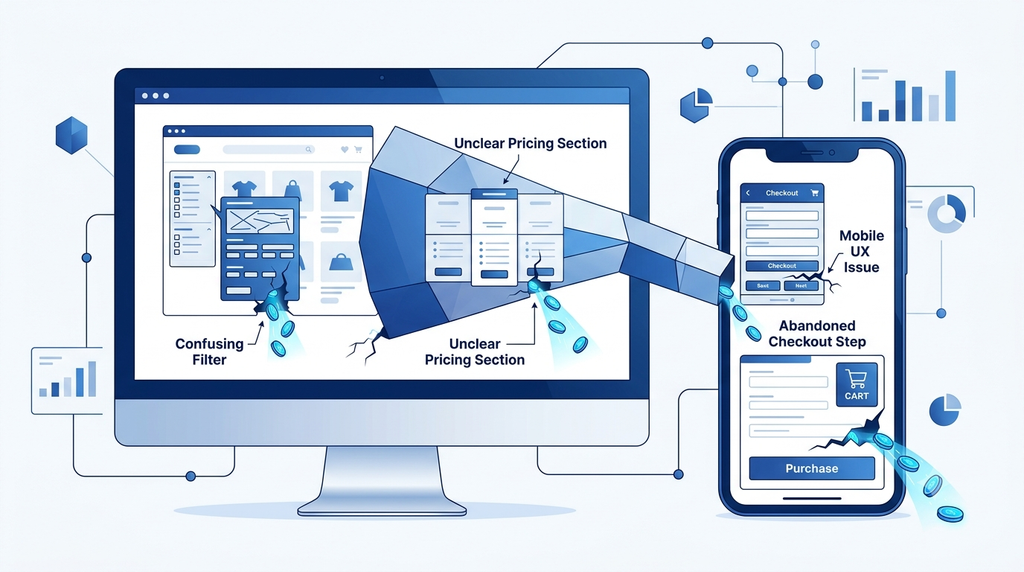
Leaks That Don’t Show Up in Standard Reports
- A revenue leak isn’t always a dramatic, obvious failure like a broken checkout button
- Instead, it’s often a small, recurring friction point
- This friction quietly reduces conversion across thousands of sessions
- Standard analytics dashboards show aggregate numbers, but they rarely explain why a number looks the way it does
- Consequently, a leak can persist for months simply because nobody noticed the pattern behind it
Why These Leaks Are Easy to Miss Manually
- Manually reviewing session recordings is time-consuming
- As a result, most teams only review a small sample
- Because of this, a friction point affecting a specific segment can go entirely unnoticed
- Mobile users on a particular browser are a common example
- Similarly, a slow-loading element under certain conditions rarely gets flagged during routine testing
- This is precisely the gap an AI-driven audit is designed to close
How AI Actually Finds These Leaks
Behavioral Pattern Analysis at Scale
- AI models can process every session, not just a sampled subset
- This scale meaningfully changes what becomes visible
- They can correlate behavior across many variables at once: device, browser, referral source, time on page, scroll depth
- Because of this scale, patterns that would never surface in manual review become statistically obvious
- For example, an AI audit might reveal that a specific traffic source consistently abandons at one step
Anomaly Detection Across the Funnel
- AI tools can flag statistical anomalies automatically, rather than waiting for a human to notice a dip
- A sudden conversion rate change for a segment gets surfaced immediately, not discovered weeks later
- This is particularly valuable for catching leaks introduced by a recent change
- A new checkout app or a redesigned page are common triggers
- Early detection, in these cases, can prevent weeks of ongoing revenue loss
Natural Language Analysis of Qualitative Data
- Many AI tools can also analyze qualitative data
- This includes support tickets, chat transcripts, and on-site survey responses
- This adds context that pure behavioral data alone can’t provide
- For example, repeated complaints about a shipping option might explain a checkout drop-off
- Behavioral data alone couldn’t fully account for that pattern on its own
- Combining both data types typically produces a more complete picture
Common Leaks an AI CRO Audit Tends to Surface
Segment-Specific Friction
- A leak affecting only one segment is exactly the kind of pattern AI is well suited to find
- A particular device or browser is a common example
- These leaks often go unnoticed precisely because overall site performance looks fine
- However, a leak concentrated in a high-value segment can still represent meaningful lost revenue
Pricing and Messaging Confusion
- AI tools can flag pages where visitors repeatedly hesitate or scroll back and forth
- This pattern often signals unclear pricing structure, not a simple lack of interest
- It can also point to unexpected costs surfacing too late in the flow
- Because this is a behavioral signal rather than an explicit complaint, it’s easy to miss without systematic analysis
Underperforming High-Traffic Pages
- A page with strong traffic but a below-average conversion rate represents a high-value leak to fix
- AI audits can rank pages by this exact combination
- As a result, they prioritize where a fix will have the largest overall impact
- This kind of prioritization is difficult to do manually across a large site with many templates
Where Human Judgment Still Matters
AI Finds the Pattern, Not the Full Explanation
- An AI audit is strong at identifying that something is happening
- However, it’s weaker at explaining why with full confidence
- Therefore, a flagged pattern should be treated as a starting point for investigation
- It shouldn’t be treated as a finished conclusion
- A human still needs to interpret the pattern against business context the model doesn’t have access to
Validating Findings Before Acting
- Before implementing a fix, it’s worth confirming the pattern holds up under closer manual review
- Watching a handful of actual session recordings helps confirm the AI’s interpretation is accurate
- This validation step, in turn, prevents wasted development effort
- Specifically, it prevents a fix aimed at the wrong underlying cause
Conclusion
AI-driven CRO audits change what’s realistically possible to find. They review far more data than a manual process ever could. As a result, they surface patterns that would otherwise stay hidden, simply because nobody had time to look closely enough. That said, the technology finds patterns; it doesn’t replace the judgment needed to interpret them correctly.
The strongest CRO programs, therefore, combine both approaches. They let AI do the heavy lifting of scanning every session for anomalies. Then, they bring in human review to confirm the finding and design the right fix. Used this way, an AI CRO audit becomes less about replacing existing processes. Instead, it’s about finally seeing the revenue leaks that were always there, just previously invisible.
Brillmark
Make your website ready for the AI era.
AI is changing how people discover, evaluate, and interact with websites. We help you identify optimization opportunities across content, UX, technical performance, SEO, and conversion paths.