Most A/B test hypotheses are written for marketers, not developers. Here’s what typically goes wrong:
- They describe a desired outcome without specifying what needs to change
- They leave out where the change should happen
- They never define how success gets measured
That gap is exactly where experimentation programs quietly break down – and where conversion rate optimization programs lose momentum. This guide closes that gap.
What is an A/B test hypothesis, and why do developers care about it?
An A/B test hypothesis is a structured prediction linking a specific page change to an expected outcome, backed by user research. According to Scribbr, a testable hypothesis must be falsifiable, specific, and grounded in observable evidence.
For developers, a hypothesis is a technical specification, not a creative brief. When a brief says ‘improve the checkout experience,’ engineers have no idea what element to target, what device to test, or how to validate the build.
Why do so many A/B test hypotheses fail before development starts?
Most failures happen at the handoff stage. AB Tasty identifies the top mistakes as hypotheses that are too broad, lack a behavioral rationale, and fail to define a winning result. Atticus Li adds that marketers focus on what they want to achieve rather than what will drive the user behavior change.
From a development standpoint, the practical failures show up as missing requirements that force engineers to ask the same clarifying questions on every single test:
- No page or URL specified – developers don’t know where to build
- No element targeting – engineers can’t identify what to modify
- No device scope – mobile and desktop require different implementations
- No tracking requirements – analysts can’t validate the data layer
- No success metric – QA has no acceptance criteria to test against
What information does a developer need before building an A/B test?
Before building, developers need a developer-ready hypothesis that answers six core questions:
| Requirement | What It Answers |
| Page / URL | Which page(s) does the test run on? |
| Element targeting | Which specific element or section is changing? |
| Device scope | Desktop, mobile, or both? |
| Success metric | Primary KPI and target lift? |
| Tracking | Which events or conversions must fire? |
| QA criteria | How will the build be validated? |
CXL confirms that defining metrics and measurement protocols before implementation is essential. Brillmark’s A/B Testing Development Services uses these six requirements as a standard intake checklist for every experiment.
How can you use a developer-ready hypothesis framework?
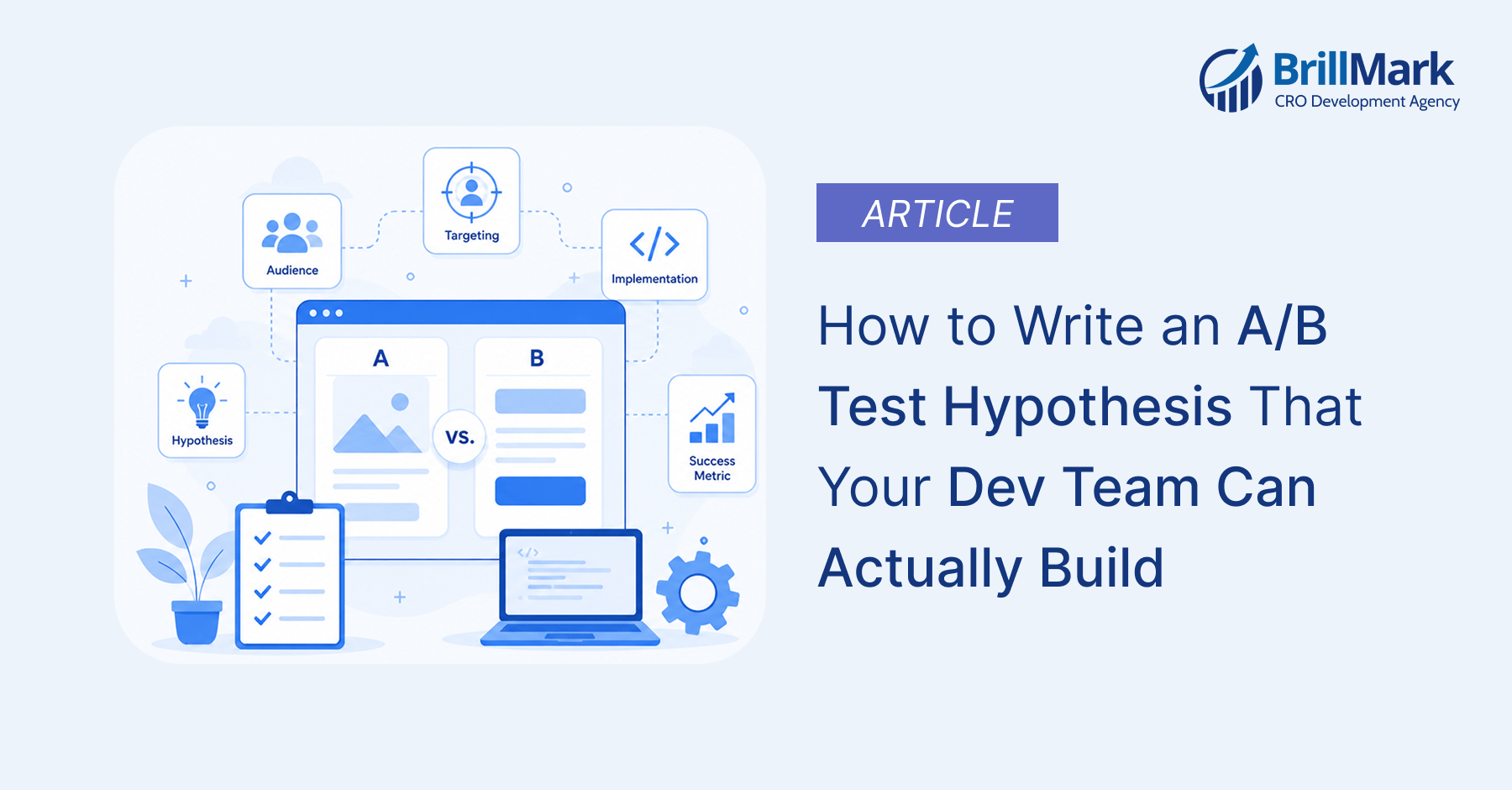
Brillmark’s eight-part framework ensures every hypothesis contains what engineers, analysts, and QA teams need to execute without guesswork.
| Component | What to Include |
| Problem | What user friction is this test solving? |
| Insight | What data or research backs this change? |
| Proposed Change | What element is changing and how? |
| Technical Scope | Which pages, devices, audience segments? |
| Success Metric | Primary KPI and target lift? |
| Tracking Plan | Which events or goals need to fire? |
| QA Requirements | Which browsers and devices should be validated? |
| Effort Estimate | Low, medium, or high? |
What does a weak A/B test hypothesis look like?
Here are three common examples and why developers cannot act on them.
| Weak Hypothesis | Why It Fails in Development |
| “Let’s test a new CTA button.” | No page, copy, or metric defined. Nothing to build. |
| “The homepage needs to feel less cluttered.” | Subjective. No targeting, no tracking plan, no success criteria. |
| “Simplify the navigation to improve engagement.” | No URL, no device scope, no measurable definition of engagement. |
As Atticus Li explains, hypotheses focused only on desired outcomes – without identifying the behavioral mechanism or the specific change, leave developers building blind.
What does a developer-ready A/B test hypothesis look like?
Here is how each weak hypothesis transforms using the Brillmark framework:
| Weak Hypothesis | Developer-Ready Version |
| “Let’s test a new CTA button.” | /pricing desktop. CTA: “Get a Quote” → “See Plans & Pricing.” Goal: 10% CTR lift. Tracking: button_click. QA: Chrome/Safari/Firefox. Effort: Low. |
| “Homepage feels cluttered.” | Remove promo banner below fold. 78% skip it. Expected: 5% scroll-depth lift. Tracking: scroll_depth_50. Effort: Low. |
| “Simplify navigation.” | Hamburger menu, 5 links, mobile only. Expected: 8% bounce rate drop. Tracking: nav_click. QA: iOS/Android. Effort: Medium. |
Each rewritten version follows CXL’s principle that specific, measurable changes produce actionable data. Brillmark’s A/B Testing Development Services can help refine your hypotheses to this standard.
How should you estimate implementation effort before prioritizing a test?
Development complexity directly affects test prioritization. A high-effort hypothesis may wait while a lower-lift test with equal potential ships in hours. Knowing the effort tier upfront prevents your experiment backlog from stalling on expensive builds while quick wins go untested.
| Effort Level | Examples |
| Low (0.5–2 days) | Copy changes, color swaps, image swaps, single-element show/hide |
| Medium (2–5 days) | Layout shifts, form changes, conditional logic, device-split targeting |
| High (5+ days) | Personalization, multi-page funnels, third-party integrations |
How can QA and analytics requirements strengthen your hypothesis?
A hypothesis without tracking and QA requirements is incomplete. Documenting both upfront prevents the two most common post-launch failures: broken tracking that corrupts data and device bugs that invalidate results.
- Event tracking: specify which clicks, form completions, or page events must fire.
- Analytics tool and event schema: GA4, Segment, or Mixpanel; document the schema.
- Browser list: which browsers and versions must pass before launch.
- Device list: which mobile models and OS versions to validate.
CXL confirms that instrumentation errors and rendering inconsistencies are among the leading causes of unreliable experimental data, both of which are preventable when QA is documented upfront.
What checklist should you review before sending a hypothesis to developers?
Confirm every item before submitting to developers:
| Pre-Submission Checklist | |
| ☐ | User insight included (research or behavioral data) |
| ☐ | Specific change identified (element, copy, or logic) |
| ☐ | Page and device scope defined (URL + device types) |
| ☐ | Success metric defined (KPI + lift threshold) |
| ☐ | Tracking plan documented (events + analytics tool) |
| ☐ | QA requirements listed (browsers + devices) |
| ☐ | Effort level assigned (low/medium/high) |
Are your hypotheses ready to build?
The shift from idea-focused to implementation-ready hypotheses isn’t about adding bureaucracy; it’s about eliminating rework before it starts. A strong A/B test hypothesis covers every element needed to make the test buildable the first time, without revision loops:
- Problem: What user friction is this test solving?
- Insight: What data or research backs the change?
- Proposed change: What element is changing and how?
- Technical scope: which pages, devices, and audience segments?
- Success metric: primary KPI and target lift?
- Tracking plan: which events or goals need to fire?
- QA requirements: Which browsers and devices to validate?
- Effort estimate: low, medium, or high?
Use the framework and checklist before every submission. Brillmark’s Full-Service Experimentation andA/B Testing Development Services cover every stage from hypothesis to launch.
Conclusion: Build It Right the First Time
The shift from idea-focused to implementation-ready hypotheses isn’t about adding bureaucracy; it’s about eliminating rework, delays, and data quality issues that arise when developers build on incomplete briefs.
A strong A/B test hypothesis documents:
- The problem and the behavioral insight behind the test
- The proposed change with precise element targeting
- The technical scope pages, devices, and audience segments
- A success metric with a defined lift threshold
- A tracking plan tied to your analytics stack
- QA requirements covering browsers and devices
- An effort estimate to prioritize the backlog intelligently
Every element serves one purpose: making the test buildable the first time, without revision loops. Use the framework and checklist before every submission, and you’ll spend less time going back and forth and more time running experiments that actually move the needle.
Ready to Turn More Test Ideas Into Successful Experiments?
Writing a strong hypothesis is only the first step. The real challenge is turning it into a test that developers can build, QA teams can validate, and analysts can measure accurately.
Brillmark helps agencies and brands bridge the gap between experimentation strategy and technical execution, covering A/B test development, analytics implementation, quality assurance, and experiment launches for 200+ agencies and global brands.
>>> Get Started with Brillmark <<<
Make your website ready for the AI era.
AI is changing how people discover, evaluate, and interact with websites. We help you identify optimization opportunities across content, UX, technical performance, SEO, and conversion paths.