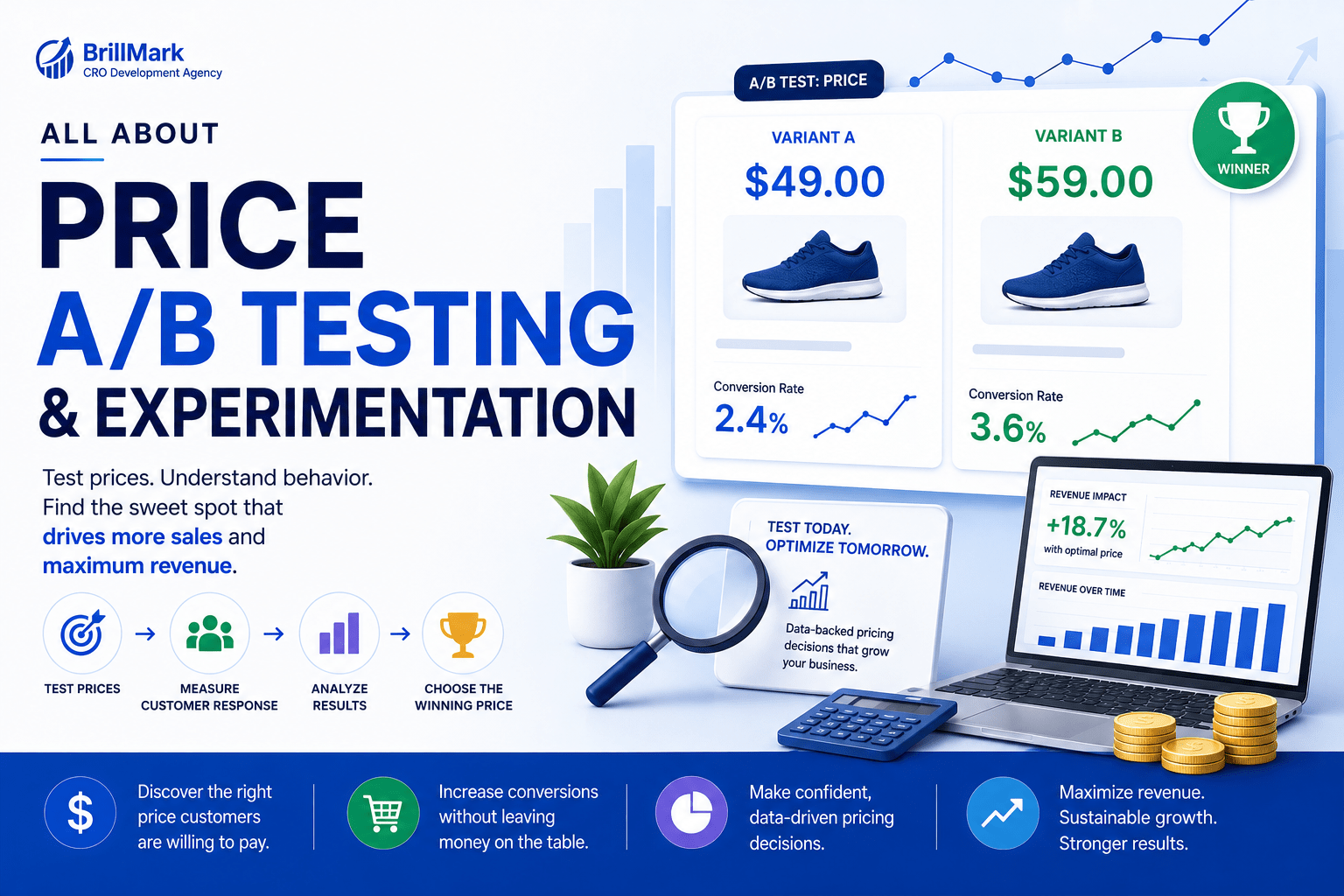
Price A/b testing is the process of running controlled experiments to see how different price points impact customer behavior, sales volume, and overall revenue. Instead of guessing what a product is worth, businesses use data to discover the optimal price that balances customer willingness to pay with maximum profitability.
How Price A/B Testing Works
Companies generally evaluate prices using four primary methods:
- Price A/B Testing: Showing different prices to separate, random segments of live website traffic at the exact same time.
- Before-and-After: Changing a price for a set period and comparing the sales data to a previous baseline timeframe.
- Cohort Segmentation: Setting varied prices based on geographical regions, sales channels, or specific customer demographics.
Why Price A/B Testing Works
Pricing can be one of the fastest ways to change your revenue trajectory,” according to a Stripe Resource Guide, because even minor adjustments flow straight to profit.
Price testing is crucial for businesses due to several key factors:
- Eliminates Costly Guesswork: Overpricing drives customers away, while underpricing leaves money on the table. Testing uncovers the exact ceiling.
- Maximizes Profit Margins: Price is the single fastest financial lever. A minor 1% to 5% price optimization requires no extra inventory costs but drastically boosts net profit.
- Measures True Demand Elasticity: It reveals exactly how a price jump affects volume. Sometimes a higher price reduces sales slightly but generates far more total revenue.
- Combats Shifting Market Costs: Inflation, rising supplier fees, and aggressive competitor discounts constantly change what a market will bear.
- Protects Brand Perception: Setting a price too low can accidentally signal poor quality to consumers. Testing identifies a premium, trusted baseline.
Best Methods for A/B Testing Pricing
Price A/B testing is a great way to find the preferred price by user, the threshold of amount they are willing to pay. Also contributes to increase AOV.
Price testing is the process of experimenting with different prices or pricing structures to find the optimal balance between conversion rate, revenue, and profit. The right method depends on your business model, traffic volume, and customer expectations
| Method | How it Works | Best For | Pros | Cons |
| A/B Price Testing | Randomly show different prices to different visitors simultaneously | SaaS, eCommerce, subscriptions | Most accurate, isolates price impact | Can create fairness/legal concerns if customers compare prices |
| Sequential Testing | Run one price for a period, then another | Low-traffic websites | Easy to implement | Influenced by seasonality, marketing, holidays |
| Geographic Testing | Test different prices in different countries or regions | Global businesses | No customer confusion | Regional demand differences affect results |
| Customer Segment Testing | Different prices for new vs returning users, B2B vs B2C, enterprise vs SMB | SaaS, marketplaces | Personalized pricing | Requires careful segmentation |
| Dynamic Pricing | Prices change based on demand, inventory, or competition | Airlines, hotels, ride-sharing | Maximizes revenue | Can reduce customer trust if not transparent |
| Discount Testing | Keep list price fixed but test different discounts (10%, 20%, Buy 2 Get 1) | eCommerce | Lower risk than changing base price | Can train customers to wait for discounts |
| Bundle Pricing Test | Test bundles instead of changing individual product prices | DTC brands, SaaS | Increases AOV | More variables to analyze |
| Tiered Pricing Test | Experiment with pricing plans and feature distribution | SaaS | Optimizes plan selection | Requires sufficient traffic |
| Van Westendorp Survey | Ask customers four pricing perception questions | New products | No live traffic needed | Measures intent, not actual behavior |
| Gabor-Granger Method | Survey customers with different price points | Product launches | Estimates willingness to pay | Survey bias |
How Does Price A/B Testing Work?
Price testing works by showing different prices (or pricing strategies) to comparable groups of customers and measuring which one produces the best business outcome, such as higher revenue or profit.
Here’s the typical workflow used by CRO teams.
Step 1: Define the goal
First, decide what success looks like.
Examples:
- Increase revenue
- Increase profit
- Increase conversion rate
- Increase Average Order Value (AOV)
- Improve Customer Lifetime Value (LTV)
For example:
Current price: $50
Question:
Would charging $55 generate more revenue even if slightly fewer people buy?
Step 2: Create pricing variants
Develop two or more pricing options.
| Variant | Price |
| Control | $50 |
| Variant A | $55 |
| Variant B | $60 |
Sometimes you don’t change the actual price. Instead you test:
- Discount percentage
- Free shipping threshold
- Bundle pricing
- Subscription discount
- Payment plans
Step 3: Split visitors
Visitors are randomly assigned to a pricing variant.
Example:
- 50% see $50
- 50% see $55
Random assignment ensures both groups are statistically comparable.
Step 4: Track customer behavior
For each group, measure:
- Product views
- Add-to-cart rate
- Checkout completion
- Conversion rate
- Revenue
- Profit
- Refund rate
| Metric | $50 | $55 |
| Visitors | 5,000 | 5,000 |
| Orders | 250 | 235 |
| Conversion Rate | 5.0% | 4.7% |
| Revenue | $12,500 | $12,925 |
| Profit | Higher? | Compare |
Although the higher price converts slightly worse, it may still generate more revenue or profit.
Step 5: Run until enough data is collected
Don’t stop after a few sales.
The test should run until you have:
- Adequate sample size
- Statistical significance
- Stable business conditions (avoid comparing holiday traffic with normal periods)
Step 6: Analyze the results
Instead of asking:
Which price sold the most?
Ask:
Which price created the most business value?
Evaluate metrics such as:
- Revenue per Visitor (RPV)
- Profit per Visitor (PPV)
- Average Order Value (AOV)
- Gross Margin
- Conversion Rate
- Customer Lifetime Value (if applicable)
Step 7: Roll out the winning price
If the higher price consistently performs better on your chosen success metric, make it the new default.
If not, keep the original price or test another option (for example, $52, $53, or a different discount strategy).
Example
Suppose an online store currently sells a product for $100.
Version A
- Price: $100
- 1,000 visitors
- 50 purchases (5% conversion)
- Revenue = $5,000
Version B
- Price: $110
- 1,000 visitors
- 47 purchases (4.7% conversion)
- Revenue = $5,170
Even though fewer customers purchased at $110, the business earned more revenue. If the profit margin remains healthy, $110 may be the better price.
Common types of Price Tests
- Direct price testing: Compare different price points (e.g., $49 vs. $59).
- Discount testing: Compare promotions such as 10% off vs. 20% off.
- Bundle testing: Compare individual products with bundled offers.
- Subscription pricing: Test monthly vs. annual pricing or different plan structures.
- Shipping pricing: Test free shipping thresholds or shipping fees.
- Price presentation: Test how the same price is displayed (e.g., “$99” vs. “$129, now $99”).
Challenges to Consider
Price testing is more sensitive than testing headlines or button colors because customers may notice different prices. Before running a test, consider:
- Customer trust if users compare prices.
- Legal and consumer-protection rules in your market.
- Effects on repeat customers.
- Impact on affiliates, coupons, and promotions.
- Inventory and demand fluctuations.
For these reasons, many businesses test pricing structure, discounts, bundles, or shipping thresholds instead of showing different base prices to users in the same market.
Types of Pricing A/B Tests
Here are the most common types of pricing A/B tests used by eCommerce, SaaS, and subscription businesses.
| Type | What You Test | Example | Primary KPI |
| Base Price Test | Different product prices | $49 vs. $59 | Revenue, Profit |
| Discount Percentage Test | Discount amount | 10% Off vs. 20% Off | Conversion Rate, Margin |
| Dollar Discount Test | Fixed discount value | $10 Off vs. $20 Off | Revenue |
| Free Shipping Threshold Test | Minimum spend for free shipping | Free shipping over $50 vs. $75 | AOV |
| Shipping Fee Test | Shipping charges | $4.99 Shipping vs. Free Shipping | Conversion Rate |
| Bundle Pricing Test | Bundle price or composition | Buy 2 for $80 vs. Buy 3 for $110 | AOV |
| Quantity Discount Test | Volume discounts | Buy 2 Save 10% vs. Buy 3 Save 20% | Units per Order |
| Subscription Discount Test | Savings for recurring purchases | Save 10% vs. Save 15% | Subscription Rate |
| Pricing Tier Test | Price of plans | Basic $19 vs. $24 | Plan Selection |
| Feature-to-Price Test | Features included in each plan | Add feature to Pro plan | Upgrade Rate |
| Anchoring Test | Reference price | $120 $99 vs. $99 only | Conversion Rate |
| Charm Pricing Test | Price endings | $49 vs. $50 | Conversion Rate |
| Payment Option Test | Payment method | Pay $299 once vs. 3 × $99 | Conversion Rate |
| Financing Test | Installment offers | Pay in Full vs. Buy Now, Pay Later | Revenue |
| Coupon Strategy Test | Coupon presentation | Auto-applied vs. Enter Coupon Code | Conversion Rate |
| Limited-Time Offer Test | Promotional urgency | Ends Tonight vs. No Deadline | Sales |
| Price Display Test | Price presentation | Monthly first vs. Annual first | Plan Adoption |
| Currency Localization Test | Localized pricing | USD vs. Local Currency | International Conversion |
Real-life Example of Pricing A/B Test
Businesses often run pricing A/B tests on things other than the base number itself. Here are additional real life case studies about the ways real companies test their pricing:
| Company | What They Tested | Why |
| Netflix | Monthly subscription price and plan structure | Maximize revenue while minimizing cancellations |
| Spotify | Free trial duration and Premium pricing offers | Increase paid subscriptions |
| Dropbox | Individual vs. Family pricing and plan positioning | Increase upgrades |
| HubSpot | Feature distribution across pricing tiers | Improve plan adoption |
| Amazon | Coupons, Subscribe & Save discounts, and bundle offers | Increase order value and repeat purchases |
| Booking.com | Discount messaging, urgency, and Genius member pricing | Increase bookings |
| Adobe | Annual vs. monthly subscription pricing | Increase annual commitments |
| Slack | Pricing page layout and Enterprise plan positioning | Increase upgrades |
How to set up a Price A/B Test in VWO
Pricing is one of the highest-impact variables you can test, but it also carries more risk than most A/B tests because it directly affects revenue, profit, and customer trust. A successful pricing experiment requires more than changing a number on a page. It involves defining clear success metrics, implementing pricing changes correctly across the entire purchase journey, and analyzing the results beyond conversion rate alone.
Setup process
- Install the VWO SmartCode.
- Create a new A/B Test.
- Enter the product or pricing page URL.
- Create Variation A (current price) and Variation B (new price).
- If testing the actual transaction amount, update the backend pricing logic based on the assigned variation rather than only editing the page visually.
- Set traffic allocation (typically 50/50).
- Define goals:
- Purchase
- Revenue
- Checkout completion
- Add to Cart
- QA the experiment.
- Launch and monitor results. VWO supports revenue metrics, custom goals, segmentation, and experimentation reporting.
How to Set Up a Price A/B test in Optimizely Web Experimentation
Setup process
- Install the Optimizely snippet.
- Create a new A/B Test.
- Choose the page or URL to target.
- Create pricing variations.
- Configure audience targeting.
- Set traffic allocation.
- Add metrics:
- Revenue
- Purchase
- Add to Cart
- Checkout
- Preview and QA.
- Publish the experiment. Optimizely guides you through creating the experiment, defining where it runs, selecting metrics, and launching it.
- Create an Experiment (Official Guide)
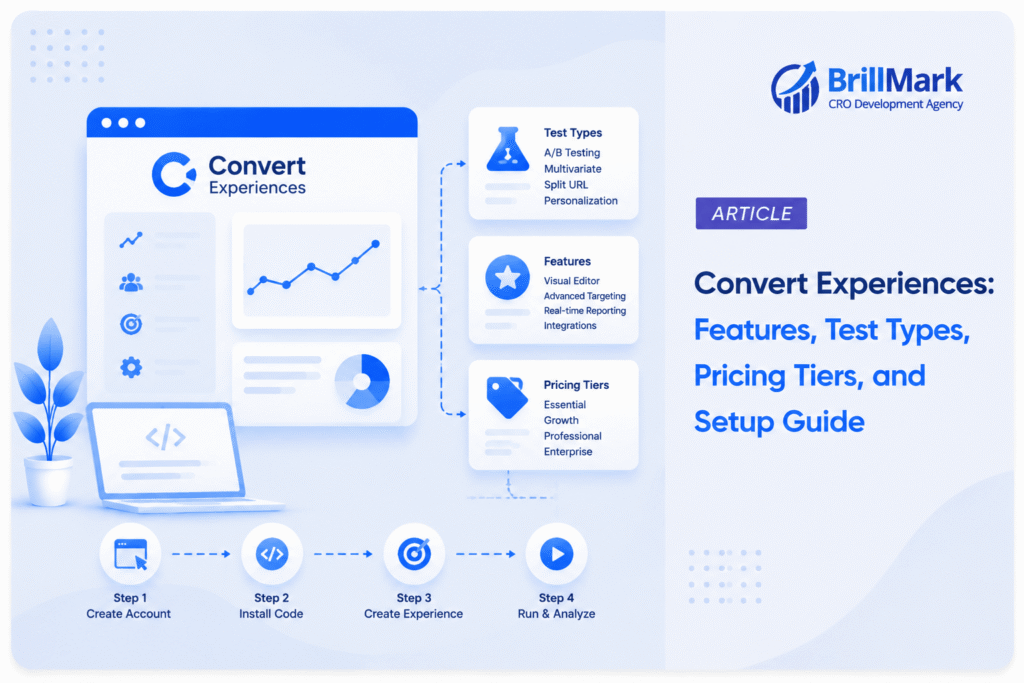
How to Set Up a Price A/B Test in Convert Experiences
Setup process
- Install the Convert tracking snippet.
- Create an A/B Experiment.
- Select the target URL.
- Create one or more pricing variations.
- Configure targeting.
- Set goals:
- Transactions
- Revenue
- Custom events
- QA across browsers and devices.
- Launch the experiment.
Conclusion
When running pricing tests, focus on business outcomes such as Revenue per Visitor (RPV), Profit per Visitor (PPV), Average Order Value (AOV), Customer Lifetime Value (LTV), and customer retention. In many cases, a higher-priced variant with a slightly lower conversion rate can generate greater overall profitability.
For businesses using platforms like VWO, Optimizely, or Convert, pricing experiments should ideally be implemented with server-side pricing logic to ensure customers see consistent prices throughout the buying journey. Client-side changes are better suited for testing price presentation, discount messaging, or promotional offers rather than the actual transaction price.
BrillMark’s CRO development team handles that end-to-end execution, building complex variations, implementing custom bandit pipelines, and making sure your test code runs fast and clean. so your team can stay on insights and growth.
Talk to our CRO engineering team →
Make your website ready for the AI era.
AI is changing how people discover, evaluate, and interact with websites. We help you identify optimization opportunities across content, UX, technical performance, SEO, and conversion paths.