
Look, holiday shopping is chaos. Your customers are stressed, your inbox is exploding, and you’re pretty sure your conversion rate just took a nap. But here’s the thing: Christmas and holiday sales are also the perfect time to run A/B tests because traffic is up, stakes are high, and even small wins can mean serious revenue.
I’ve pulled together 20 experiment ideas that eCommerce brands should test during the holidays. Let’s dig in.
Why Holiday A/B Testing Hits Different
Before we jump into the tests, quick reality check: holiday shoppers behave differently. They’re gift hunting, deadline-driven, and way more willing to spend. That means tests that flopped in July might crush it in December. The flip side? You need statistical significance fast because the window is short.
Pro tip: Start your tests early November if possible. Waiting until December 15th is like studying the night before finals. You might survive, but you won’t thrive.
The 20 A/B Test Ideas (Seasonal campaigns to shape conversion patterns)
1. Free Shipping Threshold vs. Flat Discount
What to test: “Free shipping over $50” versus “15% off your order.”
Why it matters: Shoppers are hypersensitive to shipping costs during holidays. But which offer converts better? And more importantly, which one protects your margins while still driving sales?
Test variables to consider:
- Different threshold amounts ($50 vs. $75 vs. $100)
- Messaging placement (banner, cart, product page)
- Combined offers (“Free shipping over $50 OR 10% off”)

According to research from the Baymard Institute, 48% of shoppers abandon carts due to extra costs like shipping. Free shipping thresholds address this head-on while often increasing average order value because customers add items to hit the threshold.
The “Why”: Behavioral data shows consumers often prefer saving $6.99 on shipping over $10 off a product, the “Zero Price” effect makes “Free” feel like a larger win than a calculated discount.
My take: Don’t assume discount is king. Track both conversion rate AND total revenue per visitor.
2. Countdown Timers on Product Pages
What to test: Product pages with “Order within 4 hours for Christmas delivery” versus no timer
Why it matters: FOMO Marketing is real, especially when Aunt Susan’s gift needs to arrive by the 25th. But does urgency help or hurt your brand perception?
Test variations:
- Delivery deadline timers vs. sale end timers
- Visual style (simple text vs. animated clock)
- Placement (above fold, near CTA, in cart)
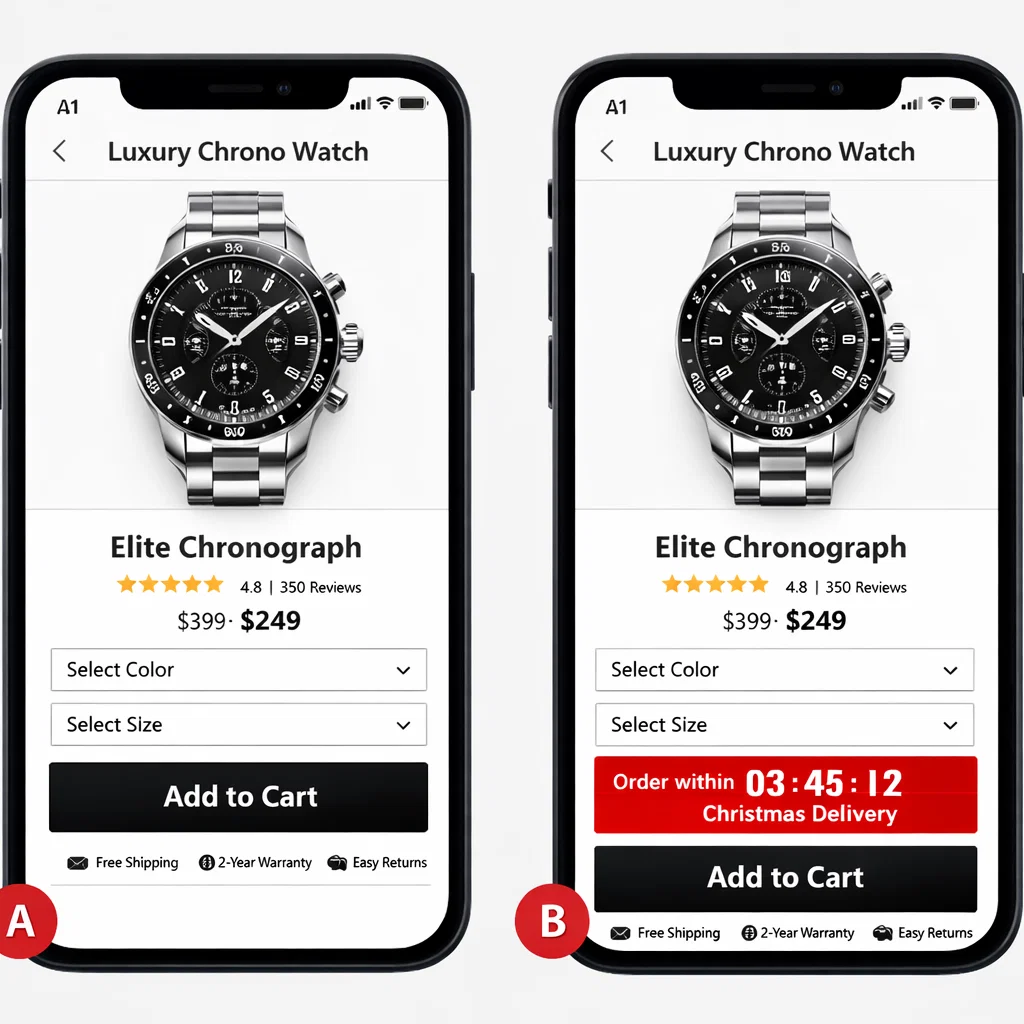
VWO’s case study library shows multiple instances where countdown timers increased conversions, though the effect varies significantly by industry and implementation.
Watch out for: CRO Case studies on Timer fatigue. If every product has a timer, none of them matter. Be selective and test frequency. Maybe only show timers on gift appropriate items or items that actually qualify for guaranteed delivery.
3. Gift Wrapping Option Placement
What to test: Adding gift wrap options at checkout versus product page versus cart
Why it matters: People forget they’re buying gifts until the last second. Making it obvious equals higher attach rate and increased AOV.
Variables worth testing:
- Visual preview of wrapped product vs. text only option
- Price points ($3.99 vs. $5.99 vs. free with purchase over $X)
- Multiple wrapping styles (classic, festive, eco friendly)
Hypothesis: Product page placement catches people while they’re in “buying mode” for that specific item. Checkout placement catches everyone but competes with other distractions. Test both and see what your data says.
4. Holiday Themed Homepage Hero vs. Product Focused
What to test: Festive “Holiday Gift Guide” hero image versus “Shop Best Sellers” with product photos
Why it matters: Does emotion sell better than product during holidays? Depends on your audience and whether they’re browsing for inspiration or hunting for specific items.
Test combinations:
- Lifestyle/emotion driven imagery with generic CTA
- Product grid with urgency messaging
- Hybrid approach (emotional image with product overlay)
Track beyond conversion: Look at bounce rate, time on site, and pages per session. Sometimes the “losing” variation actually primes people better for future visits.
An e-commerce retailer implemented a personality-based gift quiz and saw a 50% year-over-year increase in conversion rate by curing “decision paralysis” for holiday shoppers.
5. Gift Finder Quiz vs. Traditional Category Navigation
What to test: Interactive “Find the Perfect Gift” quiz versus standard “Shop by Category” menu
Why it matters: Decision paralysis is REAL during holidays. A quiz can simplify the overwhelm, but it also adds friction. Which wins?
Quiz formats to test:
- 3 questions vs. 7 questions (speed vs. personalization)
- Fun/personality driven vs. practical/filter based
- Results page showing 5 products vs. 20 products
Tools like Typeform or Octane AI make it relatively easy to build and test product recommendation quizzes without heavy development.
Implementation note: Make sure your quiz actually leads somewhere useful. A quiz that ends with “Here are 47 products!” defeats the purpose. Test curated results vs. filtered category pages.
6. Last Minute Delivery Guarantees
What to test: Prominent “Guaranteed Christmas Delivery” badge versus no mention
Why it matters: Procrastinators unite! And they’ll pay extra for peace of mind. But does highlighting deadlines create urgency or just remind people they’re late?
Badge variations:
- Color (green “safe” vs. red “urgent”)
- Placement (product listing, product page, checkout)
- Messaging (“Order by Dec 20” vs. “Only 3 days left!”)

Honest warning: Only do this if you can actually deliver. Breaking this promise equals reviews from hell and returns galore. Test conservatively and have backup plans.
Transparent and visible return policies are critical since 59% of consumers check them specifically before holiday purchases; highlighting a smooth process can increase order conversion by up to 40%.
7. Gift Message Field Placement
What to test: Gift message input on product page versus only at checkout
Why it matters: Friction reduction. The easier you make gifting, the more people do it. But does adding fields to product pages distract from the primary conversion goal?
Test configurations:
- Optional expandable section vs. always visible
- Character limits (50 vs. 200 vs. unlimited)
- Preview functionality (see what the card will look like)
Tracking tip: Measure not just usage rate but also correlation with purchase completion. If people who add gift messages abandon more, you’ve added friction in the wrong place.
8. Bundle Deals vs. Individual Products
What to test: “Holiday Bundle – Save 20%” versus individual product listings
Why it matters: Bundles increase AOV and solve the “what should I buy?” problem. But do they work better as separate SKUs or as suggested combinations?
Bundle approaches:
- Pre made bundles vs. “Build your own bundle”
- Discount structure (percentage off vs. “Buy 2 get 1 free”)
- Presentation (one product page vs. multi product widget)

Shopify’s commerce trends report consistently shows that bundled products have higher conversion rates during holiday periods, though the optimal discount level varies by category.
Consider testing: Whether bundles cannibalize your higher margin individual sales. Sometimes bundles convert better but make you less money overall.
9. Exit Intent Popups with Holiday Urgency
What to test: “Wait! Free shipping ends tonight!” versus “Join our newsletter for 10% off”
Why it matters: Exit intent can recover abandoning visitors. During holidays, urgency beats generic offers, but there’s a fine line between helpful and desperate.
Variables to experiment with:
- Offer type (discount, free shipping, free gift wrap)
- Urgency level (countdown timer vs. static message)
- Frequency caps (once per session vs. once per day vs. always)
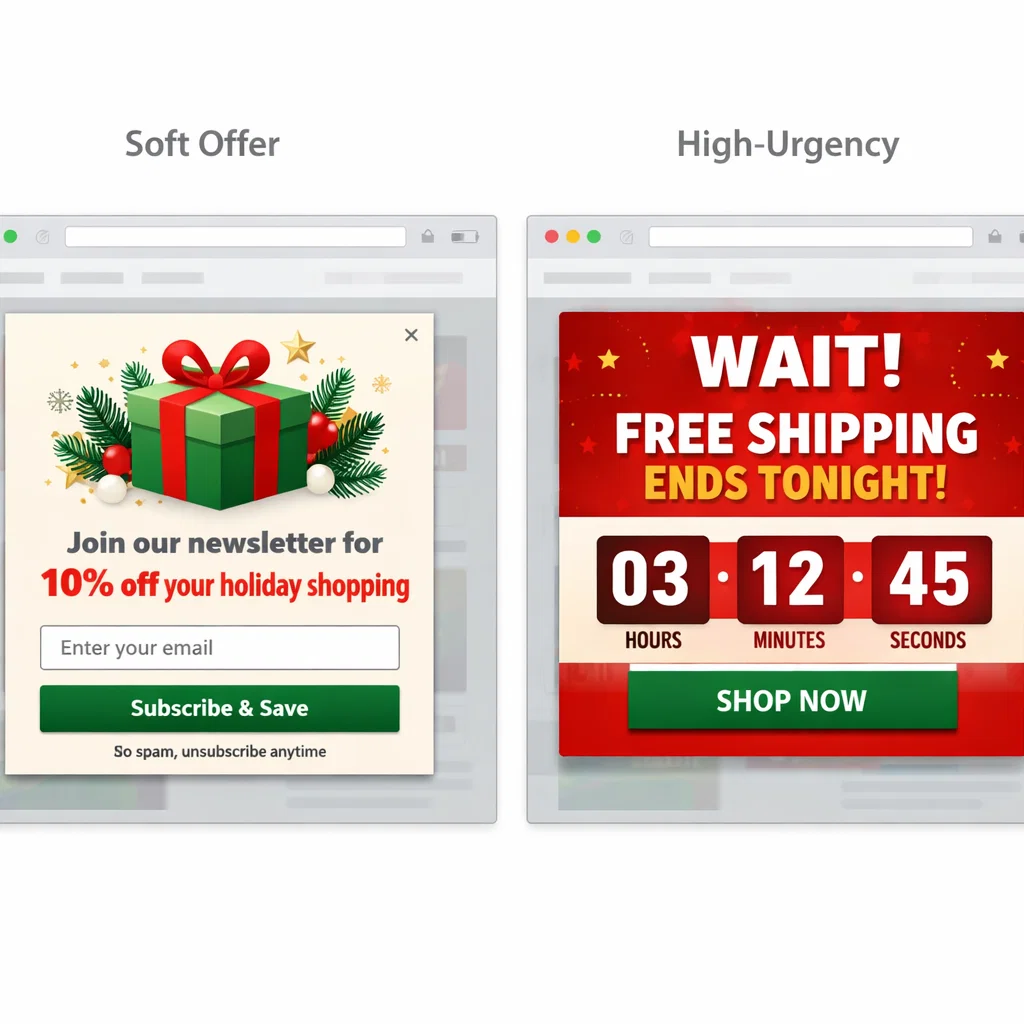
Tools like OptinMonster or Privy specialize in exit intent technology and provide built in A/B testing frameworks.
Keep it real: These work but can be annoying. Test different triggers. Maybe only show to people who’ve been on site 2+ minutes or viewed 3+ products. Quality over quantity.
10. Social Proof: Reviews vs. “X People Bought This Today”
What to test: Product reviews displayed versus live purchase notifications (“Sarah from Austin just bought this!”)
Why it matters: Different types of social proof resonate with different shoppers and price points. Which builds more trust for your audience?
Social proof formats:
- Star ratings vs. review count vs. full reviews
- Recent purchases vs. items in carts vs. people viewing
- Specific (“John from NYC”) vs. generic (“Someone just bought”)
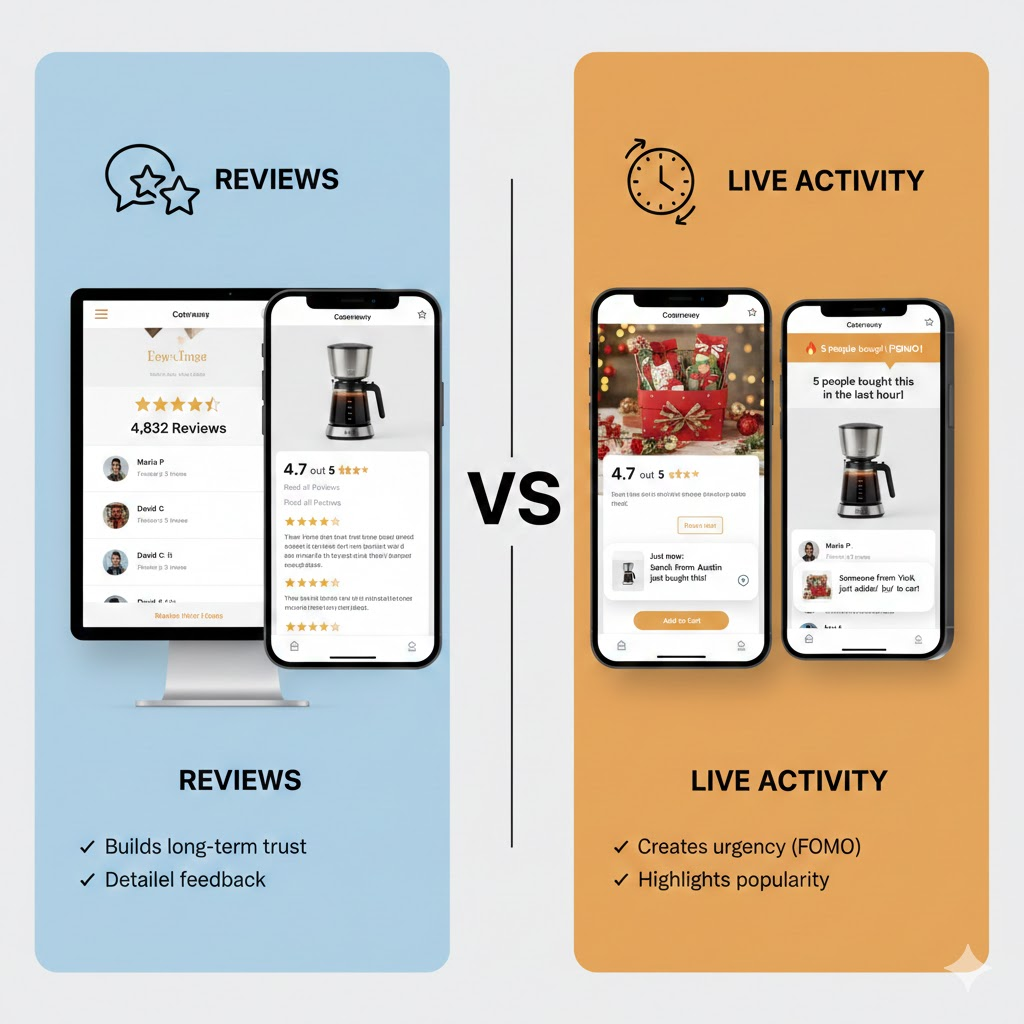
Combination hypothesis: Maybe reviews work better for considered purchases while real time notifications work for impulse buys. Test by price point or category.
11. Holiday Return Policy Visibility
What to test: “Extended returns until Jan 31st” prominently displayed versus buried in footer
Why it matters: Return anxiety kills conversions, especially for gift buyers who aren’t sure about sizes, preferences, or whether Uncle Bob already has one.
Placement tests:
- Header banner vs. product page callout vs. checkout reassurance
- Icon based vs. text based messaging
- “Free returns” vs. “Extended holiday returns” vs. specific date
Context matters: Test whether emphasizing returns increases confidence (and conversions) or just primes people to expect they’ll return stuff (and increases return rates). Track both metrics.
12. Price Display for Gifts
What to test: Offering “gift mode” with prices hidden on receipts versus standard pricing
Why it matters: Some shoppers feel awkward about recipients seeing prices, especially on expensive or cheap gifts. But does offering this option increase conversions enough to justify the complexity?
Implementation options:
- Auto hide prices on all gift orders
- Checkbox option at checkout
- Premium feature (“Gift packaging with no prices $2.99”)

Survey idea: Before building this test, survey your customers. If nobody cares, don’t waste development time. If 30% say they’d buy more, prioritize it.
13. Urgency Copy on CTA Buttons
What to test: “Add to Cart” versus “Order Now for Christmas Delivery.”
Why it matters: Context-specific CTAs can lift conversions when they address the core concern, but overly aggressive copy can feel pushy or create confusion for non-holiday shoppers.
CTA variations:
- Generic vs. deadline specific vs. benefit focused
- Button color changes to match urgency
- Dynamic CTAs (different for different visitors or dates)
Segmentation idea: Test showing holiday specific CTAs only to first time visitors or during peak gift buying dates (Dec 15 through 22). Returning customers might find it repetitive.
14. Gift Card Promotion Placement
What to test: Gift cards in main navigation versus sidebar banner versus homepage tile
Why it matters: Gift cards are low effort, high margin holiday winners, but only if people see them. Where should they live for maximum visibility?
Promotion strategies:
- Navigation prominence (top level vs. under “Gifts”)
- Bonus offers (“Buy $50 gift card, get $10 free”)
- Visual treatment (looks like product vs. special branded tile)
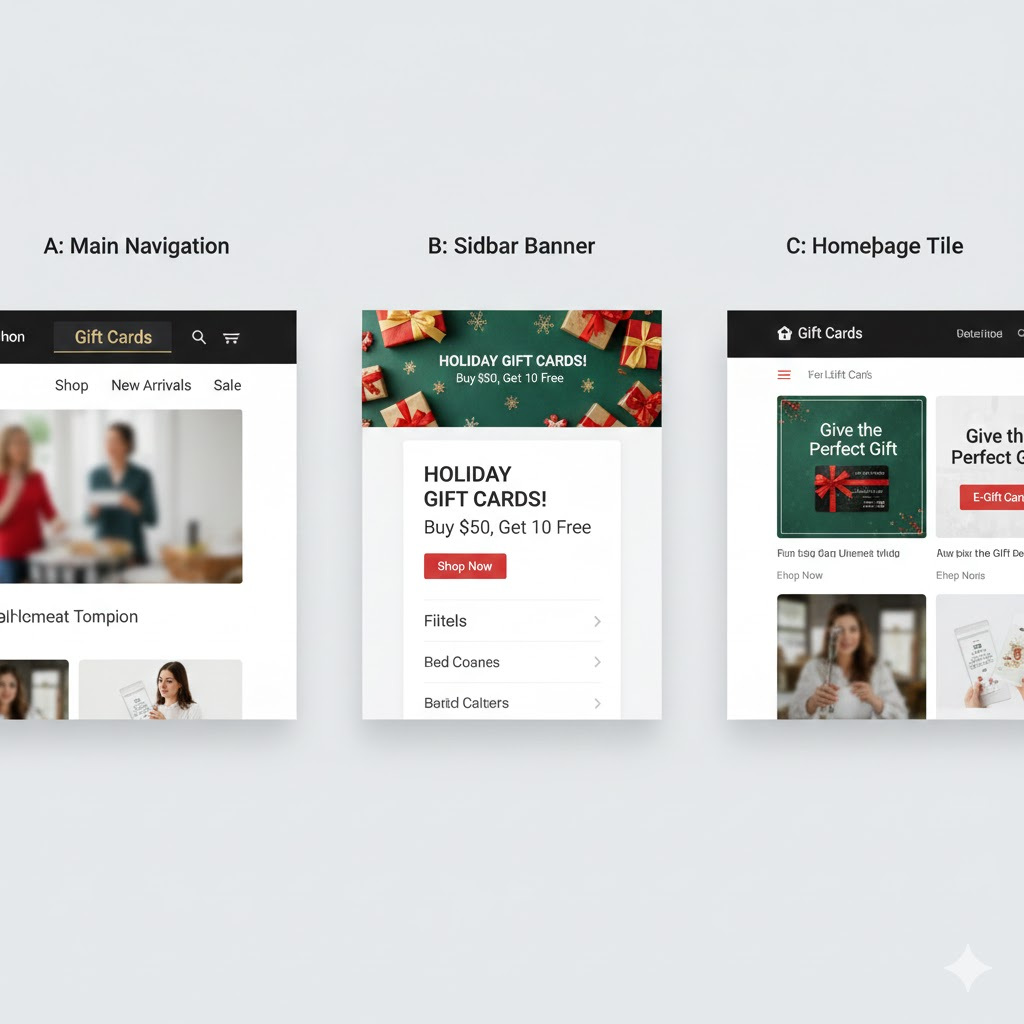
Timing test: Maybe gift cards should be more prominent in the last shopping week when panic sets in. Test different placements across different date ranges.
15. Live Chat Availability Messaging
What to test: “Chat with us about gift ideas!” versus “Questions? We’re here to help”
Why it matters: Holiday shoppers need help picking gifts. Making your chat feel gift focused might invite more engagement, or it might intimidate people who just have basic questions.
Chat prompt variations:
- Proactive vs. reactive (popup vs. static widget)
- AI chatbot vs. “Connect with gift expert”
- Timing (immediate vs. after 30 seconds vs. at scroll depth)
Platforms like Intercom or Drift provide robust A/B testing capabilities for chat widgets and messaging.
Quality over quantity: Measure not just chat initiations but conversion rate from chat sessions. More chats that don’t convert just waste resources.
16. Mobile Checkout: Guest vs. Required Account
What to test: Guest checkout versus requiring account creation
Why it matters: Mobile traffic spikes during holidays (people shopping on their couch at night). Every extra field is friction that kills mobile conversions.
Account flow options:
- Guest checkout only
- Optional account (“Save info for faster checkout next time”)
- Post purchase account creation
- Social login (Google, Apple, Facebook)
The Baymard Institute’s checkout usability research shows that the average checkout flow has 14.88 form fields, and reducing this number significantly improves mobile conversion.
The tradeoff: You’ll collect less customer data with guest checkout, so weigh that against conversion lift. Maybe test “guest checkout with email capture” as a middle ground.
17. Wishlist Sharing Features
What to test: Prominent “Share your wishlist” button versus no sharing option
Why it matters: People literally create wishlists to send to family. Making it stupid easy encourages the behavior and drives purchases from gift givers.
Sharing mechanisms:
- Email vs. text vs. link copy vs. social
- Privacy settings (public vs. private links)
- Notification when someone buys from your list (or not)
Viral potential: Test whether wishlist creators get incentives for shares (unlock 10% off when someone buys from your list). Could create a growth loop.
18. Personalization: “Gifts for Him/Her/Kids” vs. Generic Navigation
What to test: Dedicated gift category pages versus standard product categories
Why it matters: People think in “who is this for?” not “what category is this in?” But does recipient based navigation actually convert better or just create more clicks?
Navigation structures:
- Recipient based (Him, Her, Kids, Pets)
- Price based (Under $25, Under $50, Splurge worthy)
- Interest based (For Foodies, For Travelers, For Homebodies)
- Hybrid mega menu with multiple entry points
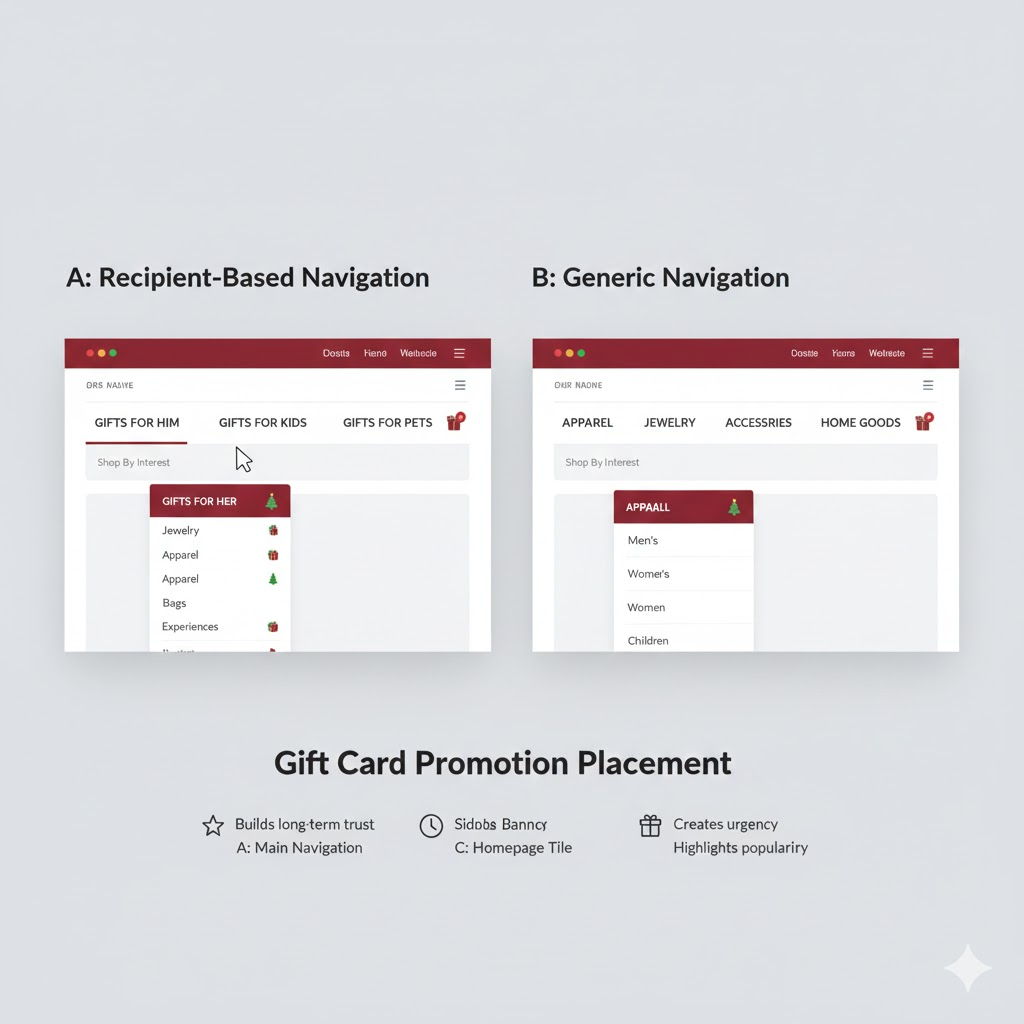
Test interaction data: Track how many clicks it takes to get to product pages with each structure. Sometimes more intuitive equals fewer clicks equals higher conversion.
19. Video Product Demos on Key Gift Items
What to test: Product pages with video demos versus static images only
Why it matters: Seeing a product in action reduces purchase anxiety, especially for gifts where you’re buying for someone else’s needs. But does video load time hurt more than engagement helps?
Video approaches:
- Auto play muted vs. click to play
- Product only demo vs. lifestyle usage
- 15 seconds vs. 60 seconds vs. 2+ minutes
- Professional vs. user generated content style
Wyzowl’s video marketing statistics report that 84% of consumers have been convinced to make a purchase after watching a brand’s video.
Mobile consideration: Video can destroy mobile load times. Test whether video helps enough on mobile to justify the performance hit, or reserve it for desktop only.
20. Post Purchase Upsells: Gift Add Ons
What to test: “Add a greeting card for $3?” on thank you page versus no upsell
Why it matters: People are already in buying mode and have their wallet out. Small, relevant add ons convert surprisingly well without feeling pushy.
Upsell options:
- Related products vs. gift add ons specifically
- Single offer vs. multiple options
- Discount incentive vs. straight price
- One click add vs. return to cart
Don’t be greedy: Test whether multiple upsells increase revenue or just create decision paralysis. Sometimes one perfect suggestion beats three good ones.
How to Actually Run These Tests (Without Losing Your Mind)
Okay, so you’ve got ideas. Now what?
Start with your biggest pain point. Is it cart abandonment? Low AOV? Nobody finding your gift section? Pick the test that addresses your actual problem, not the one that sounds coolest.
Sample size matters. You need enough traffic to reach statistical significance. If you only get 100 visitors a day, pick ONE test and commit. Don’t spread yourself thin across five mediocre experiments.
Run tests for at least one week, preferably two. Holiday traffic is weird. Weekday vs. weekend behavior differs dramatically. Cyber Monday skews everything. Account for that.
Pick the right metrics. Conversion rate is obvious, but also track AOV, revenue per visitor, cart abandonment rate, and return rate. Sometimes the “winning” variation converts better but creates other problems.
Tools you actually need:
VWO (Visual Website Optimizer) offers comprehensive A/B testing with holiday specific templates and excellent analytics.
Optimizely provides enterprise level experimentation platforms with advanced targeting and personalization.
Convert focuses on privacy compliant testing, which matters for GDPR and CCPA compliance.
For Shopify users, Neat A/B Testing integrates directly with your store without coding.
Google Optimize is sunsetting but alternatives like AB Tasty fill the gap nicely.
Have a rollback plan. If your test crashes your site on Cyber Monday or tanks conversion by 40%, you need to kill it FAST. Know where the off switch is.
The Tests That Tend to Win (Patterns Worth Knowing)
While every store is different, certain patterns emerge:
Free shipping thresholds almost always beat flat discounts for AOV (but test both for total revenue)
Countdown timers for delivery deadlines work when they’re honest and relevant
Gift wrapping visibility consistently increases attachment rates. People want this, they just forget
Extended return policies reduce anxiety without significantly increasing actual returns
Recipient based navigation (“Gifts for Dad”) often beats category navigation during holidays
Mobile friction reduction wins every time. Guest checkout, fewer form fields, faster load times
The Mistakes I’ve Seen (Don’t Be That Brand)
Testing too many things at once: You’ll never know what actually worked. Was it the button color or the headline or the image or the offer? Isolate variables.
Ignoring mobile: 60%+ of holiday traffic is mobile. Your beautiful desktop test is worthless if it breaks on iPhone.
Fake urgency: “Only 2 left!” when you have 200 in stock. Customers aren’t stupid. This kills trust and tanks long term conversion.
Not segmenting traffic properly: New vs. returning visitors behave differently. Mobile vs. desktop. Organic vs. paid. Sometimes you need separate tests.
Stopping tests too early: Getting excited about day 2 results is premature. Statistical significance exists for a reason.
Forgetting about margin: A test that increases conversion 20% but cuts margin 30% is not a win. Do the math.
Questions You’re Probably Asking
When should I start testing?
Early November, ideally. You want data before Black Friday hits so you can apply learnings to your biggest traffic days.
Can I test multiple things at once?
Technically yes (multivariate testing), but you need MASSIVE traffic for statistical significance. For most brands, sequential single variable tests are smarter.
What if my test is inconclusive?
Run it longer, increase the difference between variations (test bigger swings), or accept that maybe there’s no meaningful difference and move on.
Should I test on my entire site or just high traffic pages?
High traffic pages first. Your homepage and top 10 product pages are where you’ll get results fastest. Then expand if it works.
How do I know if my sample size is big enough?
Use a sample size calculator from Optimizely or Evan Miller’s tools. Generally, you need at least 100 to 200 conversions per variation to trust the data.
What confidence level should I aim for?
95% is standard. Don’t call winners at 80% confidence. That’s a coin flip with extra steps.
Your Holiday Testing Game Plan
Here’s how I’d prioritize if I were running your store:
Week 1 (Early November): Test free shipping threshold vs. discount offer. This impacts everything else.
Week 2 to 3: Test delivery guarantee messaging and placement. Get this right before peak season.
Week 4 (Thanksgiving week): Test homepage hero and navigation structure for gift shoppers.
Early December: Test urgency elements (countdown timers, stock indicators) on best sellers.
Mid December: Test post purchase upsells and gift add ons when traffic is highest.
Late December: Test return policy messaging for last minute shoppers and gift givers.
Look, holiday A/B testing isn’t rocket science, but it does require discipline. Pick one or two tests from this list, set them up properly, let them run long enough, and actually make decisions based on data instead of gut feelings.
Even a 5% conversion lift during Q4 can mean serious money. A 10% lift can be a company change. And if you try something that totally flops? That’s data too. Write it down, learn from it, test something else next year.

The brands that win the holiday season aren’t the ones with the biggest budgets. They’re the ones that figure out what their specific customers respond to and double down on it.
Make your website ready for the AI era.
AI is changing how people discover, evaluate, and interact with websites. We help you identify optimization opportunities across content, UX, technical performance, SEO, and conversion paths.