






The gap between brands that grow steadily and brands that plateau is rarely the tools they use. It is how they use them. High-growth ecommerce teams treat conversion rate optimization as a discipline they run every week, not a project they finish once. Here is what that looks like in practice, and where most teams fall short.
What do high-growth ecommerce brands do differently with CRO?
Q: What do high-growth ecommerce brands do differently with conversion rate optimization?
A: They run CRO as a continuous program instead of a one-time project. They connect customer research, behavioral analytics, hypothesis-driven testing, and analytics validation into a single loop that compounds over time.
Most brands redesign a page, ship a handful of A/B tests, then move on. The best brands never stop. Each test teaches them something about their customers, and that knowledge shapes the next test. The result is not one big win. It is dozens of small, validated gains that stack up.
Think of it as the difference between tactics and operating rhythm. Tactics fade. A rhythm keeps producing.
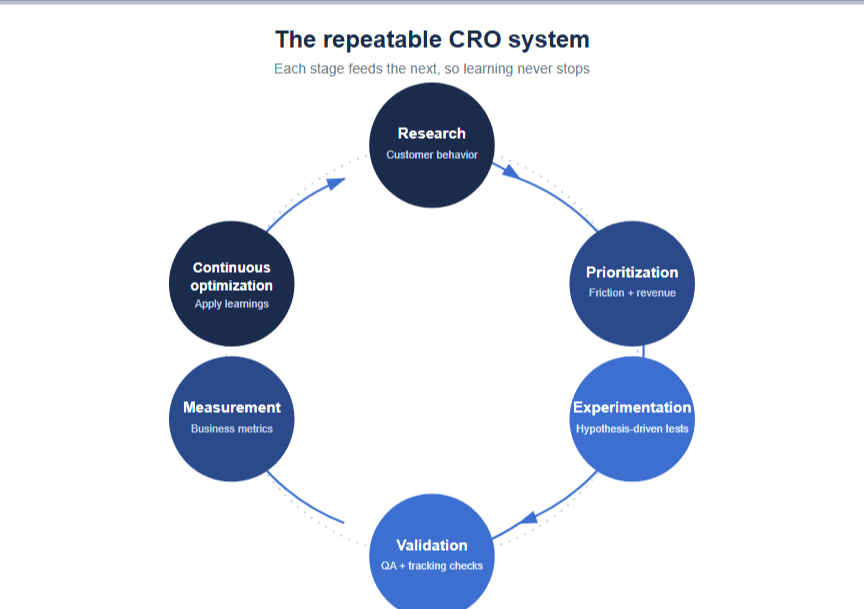
This breakdown shows how leading teams prioritize, measure, and scale their experimentation programs. Brillmark helps ecommerce teams turn these principles into repeatable programs through its CRO services and full-service experimentation support.
This creates a repeatable optimization system where every experiment contributes to future growth.
Characteristics of mature ecommerce CRO programs
| Practice | Why it matters |
| Continuous experimentation | Customer behavior changes constantly. Optimization never stops. |
| Research before testing | Tests are based on customer evidence instead of opinions. |
| Reliable analytics | Decisions rely on trustworthy data rather than assumptions. |
| Prioritized roadmap | Teams work on the highest-impact opportunities first. |
| Knowledge repository | Every experiment improves future decision-making. |
Organizations with mature experimentation programs rarely rely on isolated CRO projects. Instead, they treat optimization as an ongoing business capability.
Brillmark’s CRO services are built around this philosophy: sustainable growth comes from a repeatable ecommerce CRO strategy, not a single sprint.
Why do successful brands treat CRO as an ongoing process instead of a one-time project?
Q: Is CRO a one-time project or an ongoing process?
A: Because experimentation compounds, while one-off redesigns reset progress. A single test answers one question. A program answers hundreds, and it keeps answering them as customer behavior shifts.
That shift is the point most teams miss. Buying habits change with the season, the device, and the traffic source. A design that converted well in Q1 can quietly decay by Q4. Worse, large redesigns often replace the exact elements that were working, because no one tested them in isolation.
Continuous CRO avoids that trap:
- Insights carry forward instead of being discarded with each redesign
- Every result, win or lose, sharpens the next hypothesis
- Small validated changes compound faster than occasional overhauls
Optimizely and AB Tasty both frame experimentation maturity as a habit, not a project. Teams that want that habit without hiring a full department often use full-service experimentation partners to keep testing velocity steady.
How do high-growth brands decide what to optimize first?
Q: How do high-growth ecommerce brands decide what to test first?
A: They prioritize by business impact, not by opinion. Before building anything, they score each idea against research, data, and reach, then work down a ranked backlog.
Guesswork is expensive because every test costs cycles you cannot get back. So the strongest teams start from evidence:
- Friction pulled from support tickets, surveys, and reviews
- Revenue potential of the specific page or funnel step
- Behavioral data from Google Analytics 4 and heatmaps
- Traffic volume, so the test can actually reach significance
Simple frameworks like ICE (impact, confidence, ease) or PIE (potential, importance, ease) turn a messy idea list into a ranked queue. Convert and Hotjar both make the same case: research before you build. That research then feeds structured A/B testing development.
Leading ecommerce teams monitor multiple business metrics.
| Metric | Why it matters |
| Revenue per Visitor (RPV) | Connects conversions with revenue. |
| Average Order Value (AOV) | Measures purchasing behavior. |
| Checkout Completion Rate | Identifies purchase friction. |
| Cart Abandonment Rate | Highlights checkout issues. |
| Customer Lifetime Value (CLV) | Measures long-term customer value. |
| Repeat Purchase Rate | Indicates customer loyalty. |
| Revenue | The ultimate business outcome. |
Which metrics matter more than conversion rate alone?
Q: What metrics should ecommerce brands track besides conversion rate?
A: Track revenue per visitor, average order value, checkout completion rate, customer lifetime value, and retention. Conversion rate alone can rise while revenue falls, so mature programs measure business outcomes, not a single ratio.
Revenue and retention metrics, because conversion rate can rise while revenue falls. That happens the moment a discount lifts volume but shrinks the average order. A single ratio hides that. A fuller set does not.
Watch these alongside conversion rate:
- Revenue per visitor, the clearest single measure of growth
- Average order value, which exposes basket and pricing effects
- Checkout completion rate, where most revenue quietly leaks
- Customer lifetime value, which ties CRO to retention
- Repeat purchase rate, the signal of durable demand
Shopify makes the same argument in its CRO guidance: optimize for revenue outcomes, not vanity ratios. None of it works without clean measurement, though
Shopify recommends tracking revenue outcomes, not just rates. To measure these correctly, structure events properly. Google’s Measure ecommerce documentation explains how purchase and checkout events should be sent to GA4. Accurate setup depends on solid analytics and measurement work.
How do customer behavior insights uncover better optimization opportunities?
Q: How do behavioral analytics tools improve CRO?
A: Behavioral tools show why users leave, which numeric analytics cannot explain. Heatmaps, session recordings, scroll tracking, and on-page feedback reveal friction that a conversion report only hints at.
They show why users leave, which numeric analytics can only hint at. Analytics tells you a page loses most of its visitors. It does not tell you where they hesitated or what confused them. Behavioral data does.
The evidence comes from a few sources:
- Heatmaps show where attention and clicks actually land
- Session recordings expose the confusing steps and dead ends
- Scroll tracking reveals the content people never reach
- On-page feedback captures objections in the customer’s own words
Tools like Hotjar, Contentsquare, and Microsoft Clarity turn these signals into testable hypotheses. Nielsen Norman Group’s ecommerce usability research reinforces that observed behavior, not assumption, should drive design decisions. Those hypotheses then feed a stronger CRO roadmap.
Why do QA and analytics validation matter before running experiments?
Q: Why is QA important in A/B testing?
A: Because a broken test produces confident, wrong decisions. If a variation renders badly on mobile or a conversion event misfires, you are optimizing toward noise. That is more damaging than not testing at all, because it feels like progress.
Solid QA and analytics validation confirm the basics before launch:
- Tracking fires correctly on every variation through Google Tag Manager
- GA4 records conversions accurately
- Layouts hold up across browsers and devices
- Numbers reconcile between the testing tool and analytics
Baymard Institute research shows how small checkout breaks push buyers away, where roughly 70% of carts are abandoned. Accuracy at checkout is therefore critical. Pairing QA testing with analytics validation before launch keeps experiment data trustworthy.
How do high-growth brands approach A/B testing differently?
Q: What is the difference between how mature and immature teams run A/B tests?
A: Mature teams run hypothesis-driven tests on a roadmap and let each result inform the next. Immature teams test random ideas, stop early, and ignore statistical significance, which produces unreliable outcomes.
Random testing produces random results. Structured teams start with a hypothesis tied to evidence, then queue tests that build on each other.
Disciplined testing looks like this:
- Every test states a clear hypothesis and expected outcome
- Tests run long enough to reach statistical significance
- Results, win or lose, feed the next experiment
- A roadmap keeps testing velocity high and focused
This applies to both client-side and server-side testing across platforms like Optimizely, VWO, Convert, and Adobe Target. Convert and AB Tasty describe this roadmap approach as the core of a mature program. Executing it reliably is the job of dedicated A/B testing development and full-service experimentation teams.
Which CRO mistakes prevent ecommerce brands from scaling?
Q: What are the most common ecommerce CRO mistakes?
A: The most damaging mistakes are copying competitors, testing without research, ignoring analytics, chasing vanity metrics, and stopping optimization after one win. These habits waste cycles and erode trust in the data.
The biggest mistakes are strategic, not technical. They quietly stall growth and undermine confidence in results.
Mistakes that prevent scaling:
- Copying competitors without knowing their context or data
- Testing ideas that have no supporting research
- Ignoring analytics when interpreting results
- Chasing vanity metrics like raw clicks or bounce rate
- Ending optimization after a single successful test
BigCommerce and Shopify flag these patterns repeatedly. Avoiding them starts with disciplined CRO and reliable QA testing that keep every decision grounded in clean data.
How can you build a repeatable CRO system for long-term growth?
Q: How do you build a repeatable CRO program?
A: Connect the right people, a clear process, and the right tools into one loop. When each stage feeds the next, the program starts improving itself. That is what separates compounding growth from the occasional lucky win.
A practical version of the loop:
- Research the customer, analytics, and behavioral inputs
- Prioritize opportunities by impact with ICE or PIE
- Frame clear, testable hypotheses
- Build and launch client-side or server-side experiments
- Validate the build and confirm accurate tracking
- Measure results against revenue and retention, not just conversion rate
- Apply what you learned, then run the loop again
The people, process, and tools must stay aligned for this loop to run. Brillmark supports each stage through combined CRO, A/B testing development, and full-service experimentation services.
Frequently asked questions
Q: What is conversion rate optimization in ecommerce?
Conversion rate optimization is the practice of increasing the share of visitors who complete a valuable action, such as a purchase. In ecommerce, it combines research, analytics, and A/B testing to improve revenue, not just conversion percentage.
Q: Is CRO worth it for smaller ecommerce stores?
Yes. Smaller stores gain the most from removing checkout friction and clarifying value. Even limited traffic supports meaningful tests when you prioritize high-impact pages and measure revenue per visitor.
Q: Which tools do CRO teams use?
Teams commonly use Google Analytics 4 and Google Tag Manager for measurement, Hotjar, Contentsquare, and Microsoft Clarity for behavior insights, and Optimizely, VWO, Convert, or Adobe Target for experimentation.
Q: What is the difference between client-side and server-side A/B testing?
Client-side testing changes the page in the browser after it loads, which is faster to build. Server-side testing renders variations on the server, which reduces flicker and suits complex or performance-sensitive experiments.
Q: How long should an ecommerce A/B test run?
Run each test until it reaches statistical significance and covers at least one to two full business cycles, often two to four weeks. Stopping early on an apparent win is a common cause of false results.
Q: What is a good ecommerce conversion rate?
Average ecommerce conversion rates sit around 2 to 3 percent, but they vary widely by industry, device, and traffic source. The more useful goal is beating your own validated baseline over time.
Q: How does QA affect A/B test accuracy?
QA confirms that variations display correctly across browsers and devices and that tracking fires as intended. Without it, a broken variation or misfiring event can invalidate the entire experiment.
Ready to turn your ecommerce conversions into measurable growth?
Improving your conversion rate is only the beginning. The real value comes from understanding customer behavior, uncovering high-impact optimization opportunities, and building a structured experimentation program that delivers continuous business growth.
Brillmark helps businesses move beyond basic optimization with analytics implementation, conversion rate optimization, A/B testing development, and full-service experimentation programs. Our team has supported 200+ agencies and global brands in using data to make better decisions and drive measurable growth.
Whether you need help improving your ecommerce conversion rate, validating analytics, identifying high-impact opportunities, or building a structured experimentation program, Brillmark can help. Get started with Brillmark