
Most A/B testing QA failures are caused by broken tracking, misaligned audiences, and rendering bugs that go undetected at launch, corrupting data that teams then use to make real business decisions.
What is A/B test QA, and why does it matter for e-commerce?
- A/B test QA validates an experiment before it goes live, confirming the variant renders correctly, interactions work, tracking fires accurately, and the right users are assigned to the right variants.
- In e-commerce, poor QA means shipping decisions based on results that were never meaningful.
- A purchase event that fires twice, or an audience filter that includes returning customers in a new-user test, can each invalidate weeks of data,
- The key distinction: QA in experimentation is data integrity protection, not just bug-finding. A test can appear to function correctly while silently producing corrupted analytics.
How do QA failures corrupt experiment data?
The most dangerous failures are invisible, the test runs, numbers appear, and teams draw conclusions from data that was never reliable.
Four QA failure types each one corrupts data differently before a decision is ever made:
- Missing events → Under-counted conversions → Winner declared loser and never shipped
- Duplicate events → Inflated conversion rate → False winner shipped to all users
- Wrong attribution → Revenue credited to wrong variant → Revenue impact miscalculated
- Audience contamination → Sample groups overlap or skew → Undetectable result bias
Setup, visual, and functional QA
Before validating any variant, confirm the experiment is configured correctly; targeting and allocation errors contaminate the entire test.
Setup Checks:
- Target URLs are correct
- Traffic split matches the test plan
- Audience rules verified
- No experiment overlaps on the same element
Visual QA:
- Variant renders on desktop + mobile
- Tested in Chrome, Firefox, Safari, and Edge
- Pricing, images, and CTAs display correctly
- No layout shifts introduced by script
Functional QA:
- Add-to-cart works in all variants
- Checkout completes end-to-end
- Product selectors and filters work
- Page speed is not degraded by the variant
Analytics QA and event validation
Analytics QA is the most neglected and most critical layer a test with perfect visuals and flawless functionality can still produce corrupted data if conversion events are misconfigured.
Five-step event validation: every conversion event must pass this before launch:
- Step 1– Trigger the action in the variant
- Step 2-DebugView confirms the event fires exactly once
- Step 3 -GTM Preview verifies tag triggers, variables, and parameters
- Step 4 -GA4 Realtime shows the event in the correct property
- Step 5 – Key event is marked and validated in GA4 Admin → Events
Analytics validation checklist:
- GA4 DebugView confirms each event fires exactly once per user action
- GTM Preview verifies tag triggers, variables, and parameters
- Variant assignment passes as a custom dimension or event parameter
- Key events are configured correctly in GA4 Admin → Events
- Events fire on user interaction only- not on page load
- purchase event fires once per order and does not duplicate on page refresh
- Revenue value and transaction ID match the actual order
Revenue duplication risk:
- On Shopify and many platforms, the order confirmation page can be reloaded
- Without a deduplication check, the purchase event fires multiple times per order
- This inflates revenue data and creates false winners
Pre-launch QA checklist
Use this table as your go/no-go reference before every experiment launch.
| Category | Check | Risk |
| Setup | Target URLs are correct and verified | High |
| Setup | Traffic allocation matches the test plan | High |
| Setup | No experiment overlaps on the same element | Med |
| Visual | Variant renders on desktop + mobile | High |
| Visual | Tested across Chrome, Firefox, Safari, Edge | High |
| Functional | Add-to-cart and checkout work in all variants | High |
| Analytics | Events verified in GA4 DebugView + GTM Preview | High |
| Analytics | Key events configured and firing correctly | High |
| Revenue | Purchase event fires once — no duplicates on reload | High |
| Revenue | Revenue value and transaction ID are correct | High |
| Audience | Variant assignment is sticky across sessions | High |
| Audience | Audience exclusion rules confirmed | Med |
A/B Testing Development Full-Service Experimentation
What Good eCommerce A/B Test QA Actually Looks Like in Practice
It’s easy to read an A/B test QA checklist and treat it as a formality. Something to scan before hitting publish. But the gap between teams that run reliable experiments and teams that don’t usually comes down to one thing: whether analytics validation is treated as a step or a standard.
Two real experiment outcomes illustrate this well.
When a Single Navigation Change Produced +18% Revenue Per User
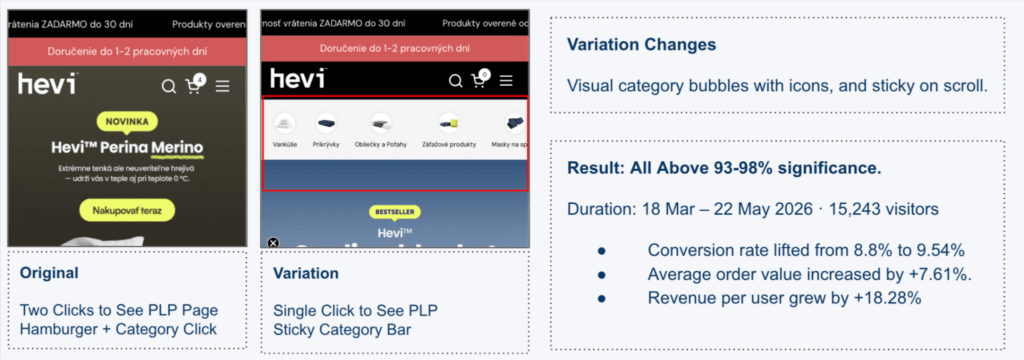
A mobile-only A/B test on a home goods store looked at what happens when product categories get moved out of a buried hamburger menu and into a persistent horizontal scroll bar below the header.
The hypothesis was simple. If users can see categories without an extra tap, more of them will reach product pages.
The experiment ran for roughly two months across more than 15,000 mobile visitors and landed at 93 to 98% statistical significance. Conversion rate moved from 8.8% to 9.54%. Average order value rose 7.61%. Revenue per user grew by over 18%.
That kind of result doesn’t happen by accident.
A sticky category bar is a persistent UI element that appears on every scroll, which means it had to be validated across every major mobile browser, at different scroll depths, and with every existing conversion tracking tag still firing correctly underneath it.
An experiment script loading a dynamic navigation element is exactly the kind of change that can quietly interfere with the existing analytics setup.
Without functional QA confirming add-to-cart still worked in the variant, and without event validation confirming conversion events weren’t duplicating on scroll, those numbers would have been meaningless. Or worse, confidently wrong.
When a Full Redesign Doubled Conversion Rate
A separate eCommerce experimentation project involved migrating a specialty store to a newer platform and rebuilding the UI from scratch with CRO best practices throughout. Simplified collection pages, image-based product options with automated pricing, interactive product pages with real-time customization previews.
In the two months after launch, the conversion rate went from 0.99% to 2.06%. A 108% improvement. Orders fulfilled rose 62.4%. Add-to-cart rate jumped from 2.45% to 6.42%, a 161.6% lift.
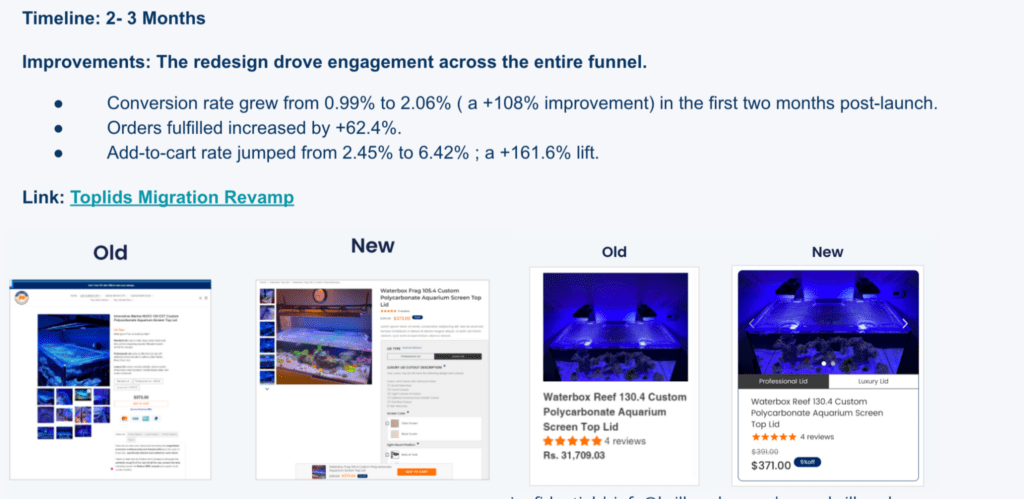
A redesign at this scale is an A/B test QA stress test in itself.
Every element that changed had to be validated for both functionality and conversion tracking accuracy. The add-to-cart event alone touches multiple potential failure points: the button interaction, the GTM tag trigger, the variable passing item data, and the purchase event that follows.
With automated pricing updates and image-based product options in the mix, the revenue tracking surface got considerably more complex.
A purchase event firing on a dynamically priced item without a deduplication check is exactly the scenario that produces inflated revenue data and misplaced confidence in experiment results.
The 108% conversion rate lift is only a trustworthy number because the experiment tracking held up.
The Pattern These Examples Share
Neither result came from a simple test with simple tracking. Both involved UI changes that touched existing analytics scripts, introduced new interaction points, and required clean event validation before anyone could responsibly read the experiment data.
That’s the real argument for eCommerce A/B test QA. Not that things will break visually, because they usually look fine.
It’s that conversion tracking can break invisibly. A test can run, produce numbers, get analyzed, and drive real business decisions while measuring something that was never configured correctly in the first place.
The experiments worth trusting are the ones where someone validated the events, verified the purchase tracking, and confirmed the audience rules before the first visitor was ever bucketed.
Most common QA mistakes to avoid
- Skipping analytics validation. Teams verify the visual renders – few verify the events measuring them.
- Testing only on desktop Chrome. Mobile Safari and Firefox render experiment scripts differently. Always test across all major browsers and devices.
- Not validating purchase tracking. Experiment scripts can interfere with existing e-commerce tags- never assume revenue tracking is unaffected.
- Skipping the control. A broken or unintentionally altered control is just as damaging as a broken variant.
- Launching without audience verification. Targeting rules that appear correct in the dashboard often behave differently in practice, especially with combined AND/OR
Conclusion: Your experiment is only as good as your data
- An A/B test that ships with broken tracking, unvalidated revenue events, or contaminated audiences doesn’t just fail, it actively misleads.
- It produces numbers that look like results, gets analyzed like results, and drives business decisions like results, while measuring nothing real.
- The purpose of e-commerce experimentation is to replace guesswork with evidence, but only if the evidence is trustworthy.
- A structured QA process is what separates data you can act on from data that creates false confidence.
Before every launch:
- Validate your events
- Verify your purchase tracking
- Confirm your audience rules
- The cost of skipping QA- a shipped loser, a missed winner, a team that loses trust in its own data- is far higher than the investment in getting it right.
- Build experiments worth trusting. Start with QA.
Ready to launch A/B tests you can trust?
Building an A/B test is only part of the process. Without proper QA, tracking errors, targeting issues, and data discrepancies can undermine your results and lead to costly decisions.
Brillmark helps businesses launch reliable experiments through:
- A/B testing development and implementation
- Analytics validation and conversion tracking
- Quality assurance for experimentation programs
- Full-service experimentation at scale
Our team has supported 200+ agencies and global brands in building experiments that generate trustworthy insights and measurable growth.
Make your website ready for the AI era.
AI is changing how people discover, evaluate, and interact with websites. We help you identify optimization opportunities across content, UX, technical performance, SEO, and conversion paths.